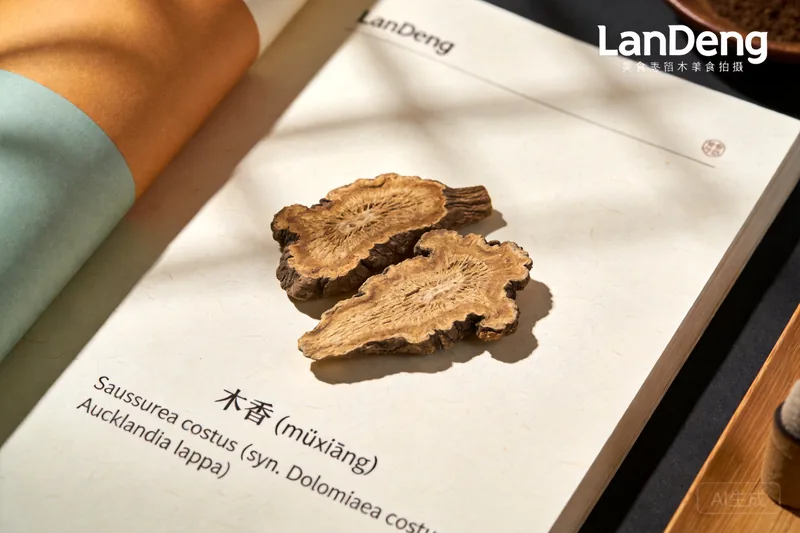
Technical answer: Costus — mùxiāng (木香) in Chinese — is the dried root of Saussurea costus (now often Dolomiaea costus, also known by the older name Aucklandia lappa), a thistle-family herb (Asteraceae) native to the Himalaya. It is a classical Chinese incense and materia-medica root valued for a deep, earthy, slightly musky-animalic aroma that made it a traditional fixative and, historically, a lower-cost stand-in for musk. It is a CITES-listed species whose wild trade is restricted.
Key facts
| Chinese | 木香 (mùxiāng), also 广木香 / 云木香 |
| Botanical source | Saussurea costus (syn. Dolomiaea costus, Aucklandia lappa) — the root |
| What it is | A dried aromatic root, not a wood or resin |
| Aroma | Earthy, woody, musky, slightly animalic |
| Traditional role | Fixative, musk-like note, materia medica |
Aroma profile
Costus root is earthy and woody at its base, with a musky, faintly animalic edge that deepens and persists — the quality that made it a traditional fixative and a lower-cost musk substitute. It is a grounding note, closer in spirit to spikenard or orris root than to a bright flower or spice. The aroma develops with gentle heat and lingers.
Botanical source and origin
Saussurea costus is a herbaceous perennial of the Asteraceae (thistle/daisy) family, native to the high Himalaya — Kashmir, northern India, Nepal, and into Tibet. The part used is the thick, aromatic root. The plant’s taxonomy has shifted: it has been known as Aucklandia lappa, Saussurea lappa, and Saussurea costus, with the currently accepted name Dolomiaea costus.
A naming caution: 木香 in Chinese names several different aromatic roots. The classical incense and materia-medica 木香 is Saussurea costus (广木香 / 云木香). Other “muxiang” — including 川木香 (Vladimiria souliei) and 青木香 (Aristolochia species) — are distinct plants, and 青木香 carries a specific safety concern. A label saying only 木香 does not identify the species.
In Chinese tradition
- Fixative and musk-like note: costus root’s deep, musky-animalic character made it a classical fixative in incense and perfumery, and historically a lower-cost substitute for genuine musk.
- Materia medica: 木香 is a standard item in traditional Chinese medicine, recorded for aromatic and digestive uses. This is traditional materia-medica language, not modern clinical evidence.
- Trade history: costus was a valued import from the Himalaya and Kashmir along historical trade routes.
Traditional use vs modern evidence
The fixative and aromatic roles are documented. Medicinal uses are traditional, not established clinical fact, and we make no medical claims. The documented, non-medical facts are botanical identity, the root’s musky-fixative use, and the CITES restriction on wild trade.
Quality and sourcing notes
Costus root is genuinely restricted: Saussurea costus is listed under CITES Appendix I (with the wild trade heavily restricted), reflecting over-harvesting of a slow-growing Himalayan plant. Practical points for buyers:
- The root should be clean, dense, and deeply earthy-musky when gently warmed.
- Because wild sourcing is restricted, cultivated material and substitutes appear in commerce; confirm species and legal origin when buying.
- Distinguish 木香 (costus) from 川木香 and 青木香 — different roots, and 青木香 carries its own safety concern.
Safety
Incense combustion produces smoke and particulate matter. Burn in a well-ventilated space, avoid inhaling concentrated smoke, and keep away from children and pets. This is editorial knowledge content, not medical advice.
FAQ
What is costus root? The dried root of Saussurea costus (now Dolomiaea costus, formerly Aucklandia lappa), a thistle-family herb native to the Himalaya. It is a classical Chinese incense and materia-medica root valued for a deep, earthy, musky, slightly animalic aroma. It is called 木香 (mùxiāng) in Chinese, and its trade is restricted under CITES Appendix I.
Why is costus described as a musk substitute? Because its deep, musky-animalic character resembles musk’s grounding, persistent quality, so it was historically used as a lower-cost fixative and stand-in for genuine musk in incense and perfumery. It is a botanical material, not an animal product, and its musky edge comes from the root’s own aromatic chemistry.
What does costus smell like? Earthy and woody at the base, with a musky, faintly animalic edge that deepens and lingers. It is a grounding, persistent note — closer in spirit to spikenard or orris root than to a flower or spice — and the aroma develops with gentle heat. This persistence is what made it a traditional fixative.
Is 木香 a single plant? No — the name is used for several different aromatic roots. The classical incense and materia-medica 木香 is Saussurea costus (广木香 / 云木香). Other “muxiang” include 川木香 (Vladimiria souliei) and 青木香 (Aristolochia species), which are distinct plants — and 青木香 carries a specific safety concern. A label saying only 木香 does not identify the species.
Is costus root endangered? Yes, it is a conservation concern. Saussurea costus is a slow-growing Himalayan plant that has been over-harvested, and it is listed under CITES Appendix I, which heavily restricts international trade in wild-collected material. This drives cultivated material and substitutes into commerce, so species and legal origin should be confirmed when buying.
See also: spikenard-nardostachys, orris-root, and the full scent guide.
Evidence & Sources
Botanical identity
Source: Saussurea costus on GBIF · Dolomiaea costus on GBIF · Saussurea costus on the CITES checklist. Evidence type: Established.
Traditional Chinese use
Source: 木香 as a fixative, musk-like aromatic, and materia-medica root. Evidence type: Historically documented — traditional materia-medica language, not modern clinical evidence.
Authenticity / sourcing
Source: Saussurea costus CITES Appendix I listing and the 木香 vs 川木香 vs 青木香 disambiguation. Evidence type: Practical screening.
Safety
Source: incense combustion produces smoke and particulate matter; burn in a well-ventilated space. Evidence type: Established.
Evidence status
| Layer | Status |
|---|---|
| Botanical identity | Established |
| Traditional use | Historically documented |
| Authenticity test | Practical screening |
| Health claims | Not established |
Sources
Sources: botanical references on Saussurea costus (syn. Dolomiaea costus, Aucklandia lappa) and its CITES Appendix I listing. Costus root’s fixative and aromatic roles are documented; medicinal uses are treated as traditional, not established clinical fact. This is editorial knowledge content, not medical advice.