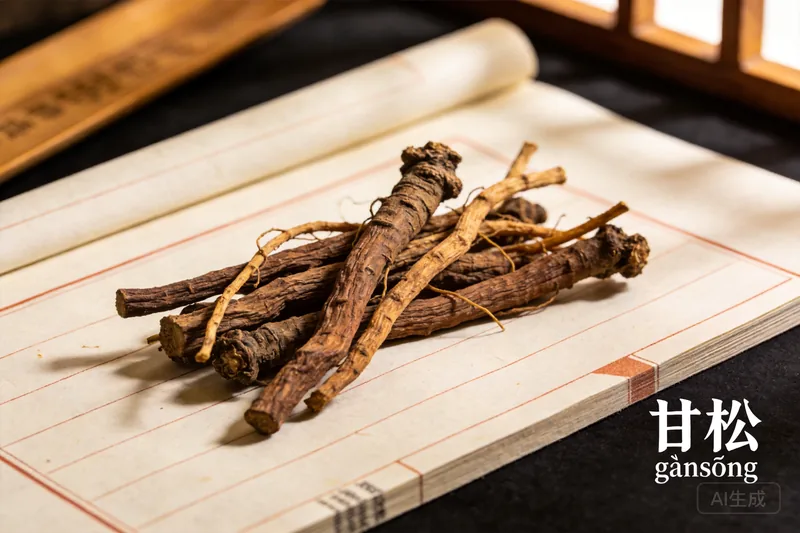
Technical answer: Spikenard — gānsōng (甘松) in Chinese — is the dried, fragrant root of Nardostachys jatamansi, a small perennial herb of the Himalayas and the mountains of western China. In Chinese incense it is a classical huxiang (合香) blending material, valued for a deep, earthy-sweet, slightly musky root note rather than for burning alone. It shares the same aromatic family as the “spikenard” (nard) of the ancient Mediterranean and Indian perfume traditions.
Key facts
| Chinese | 甘松 (gānsōng), also 甘松香 |
| Botanical source | Nardostachys jatamansi (family Caprifoliaceae) — the dried root/rhizome |
| What it is | A dried aromatic root, not a wood or resin |
| Aroma | Earthy, woody, sweet, with a musky, slightly animalic undertone |
| Traditional role | 合香 (blended incense), scenting clothes (裛衣), bath |
Aroma profile
Spikenard root is earthy and woody at its base, with a sweetness that is more “rooty” than floral and a musky, faintly animalic edge. It is a supporting note: it deepens and grounds a blend rather than leading with a bright top note. The aroma develops with gentle heat, which is why it appears repeatedly in classical huxiang formulas alongside woods and resins.
Botanical source and origin
Nardostachys jatamansi is a small herb native to the high Himalaya — Nepal, Bhutan, northern India, and into Tibet and western Sichuan. The part used is the root and rhizome, which is harvested, cleaned, and dried. The name 甘松 (“sweet song”) refers to its sweet taste (甘) — an older, taste-based naming convention rather than a description of its scent.
A naming caution: Chinese 甘松 is not the same material as “spikenard” sold as an essential oil in Western aromatherapy under the same English name, though both trace to Nardostachys. Labels that say only “spikenard” may come from different species or grades. See the note below.
In Chinese tradition
- 合香 (blended incense): 甘松 is a classical supporting ingredient in blended incense formulas, contributing an earthy, grounding body. The Song-dynasty manual Xiangpu (香譜) records 甘松香 among the standard incense materials.
- Scenting clothes (裛衣): classical texts describe spikenard as usable to scent garments and for fragrant bathing.
- Materia medica: 甘松 appears in traditional Chinese medicine, where the Bencao Shiyi (本草拾遗) records it for various uses and notes “bathing makes the body fragrant” (浴人身令香). This is traditional materia-medica language, not modern clinical evidence.
Traditional use vs modern evidence
The classical references describe spikenard’s aromatic and cultural roles — blending, scenting, bathing — and a traditional medicinal reputation. We treat the medicinal descriptions as traditional, not established clinical fact, and make no medical claims. The documented, non-medical facts are botanical identity and the plant’s long use as a fragrant root in Chinese, Indian, and Himalayan incense traditions.
Quality and sourcing notes
Genuine spikenard root is increasingly scarce because wild Nardostachys is harvested from sensitive Himalayan habitats and has been listed under CITES Appendix II (the trade is monitored). As a result, “spikenard” on the market can vary in species and grade. Practical notes for buyers:
- The material should be a clean, dried root with a noticeable earthy-sweet aroma when gently warmed.
- Because wild sourcing is restricted, cultivated material and substitutes (including the unrelated sedge Cyperus, a traditional huxiang root sometimes used in spikenard’s place) appear in commerce.
Safety
Incense combustion produces smoke and particulate matter. Burn in a well-ventilated space, avoid inhaling concentrated smoke, and keep away from children and pets. This is editorial knowledge content, not medical advice.
FAQ
What does spikenard smell like? Spikenard root is earthy and woody with a sweet, slightly musky, faintly animalic undertone. It is a supporting, grounding note rather than a bright or floral one — in Chinese huxiang (blended incense) it deepens a formula from below, alongside woods and resins. The aroma is “rooty” and develops with gentle heat, which is why it is blended rather than burned alone for fragrance.
Is Chinese 甘松 the same as Western spikenard essential oil? They trace to the same plant family — Nardostachys — but the materials are not automatically identical. Chinese 甘松 is the dried root used in incense and materia medica, while “spikenard” in Western aromatherapy is usually a steam-distilled essential oil of the same genus. A label that says only “spikenard” does not specify species or form, so buyers should check what they are getting.
What part of the spikenard plant is used? The dried root and rhizome of Nardostachys jatamansi are the parts used. The plant is a small Himalayan herb; its root is harvested, cleaned, and dried, then used whole, sliced, or powdered in incense and traditional practice. The name 甘松 refers to the root’s sweet taste rather than its scent — an older, taste-based naming convention.
Why is spikenard so associated with blended incense? Because its aroma is a grounding, earthy body note rather than a self-sufficient fragrance, spikenard works best in combination. The Song-dynasty manual Xiangpu (香譜) lists 甘松香 among the standard incense materials, and classical huxiang formulas pair it with woods (sandalwood, agarwood), resins, and other roots. It contributes depth and warmth that other ingredients do not supply on their own.
Is spikenard rare? Genuine wild spikenard has become scarce because Nardostachys jatamansi is harvested from sensitive high-Himalayan habitats and its trade is monitored under CITES Appendix II. This has led to cultivated material and substitutes appearing in commerce — including the traditional huxiang root Cyperus (香附子), sometimes used in spikenard’s place. Rarity and sourcing pressure are worth checking when buying.
See also: sandalwood, vetiver, and the full scent guide.
Evidence & Sources
Botanical identity
Source: Nardostachys jatamansi in Flora of China · Nardostachys jatamansi on GBIF. Evidence type: Established.
Traditional Chinese use
Source: the Song-dynasty Xiangpu (香譜, “Incense Manual,” 洪芻) records 甘松香 among standard incense materials, citing 《本草拾遺》 (“bathing makes the body fragrant,” 浴人身令香) and 《廣志》 (origin in 涼州). Evidence type: Historically documented — traditional materia-medica language, not modern clinical evidence.
Authenticity / sourcing
Source: Nardostachys jatamansi wild-harvest scarcity and CITES Appendix II monitoring; the Cyperus (香附子) substitution note. Evidence type: Practical screening.
Safety
Source: incense combustion produces smoke and particulate matter; burn in a well-ventilated space. Evidence type: Established.
Evidence status
| Layer | Status |
|---|---|
| Botanical identity | Established |
| Traditional use | Historically documented |
| Authenticity test | Practical screening |
| Health claims | Not established |
Sources
Sources: botanical references on Nardostachys jatamansi and the Song-dynasty Xiangpu (香譜) record of 甘松香. Medicinal uses are treated as traditional, not established clinical fact. Traditional-use proportions and formula quantities are recorded as historical references, not verified. This is editorial knowledge content, not medical advice.