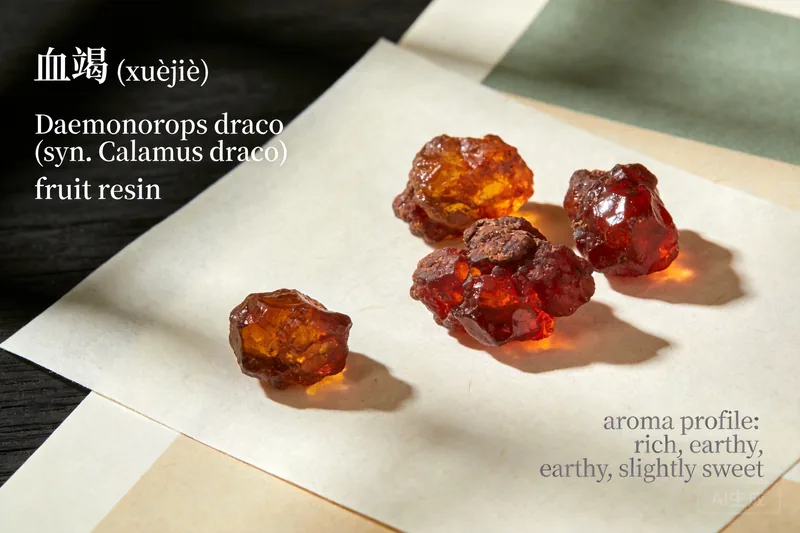
Technical answer: Dragon’s blood — xuèjié (血竭) in Chinese — is a bright red resin obtained from the fruit of Daemonorops draco (now often placed in Calamus), a climbing rattan palm of the Arecaceae family native to Southeast Asia. It is a resinous incense and pigment material with a sweet, woody, balsamic scent and a deep red color, used in Chinese incense, lacquer, and materia medica. The name covers several unrelated red resins, but Daemonorops draco is the classical “dragon’s blood” of the incense and pigment trade.
Key facts
| Chinese | 血竭 (xuèjié) |
| Botanical source | Daemonorops draco (syn. Calamus draco, family Arecaceae) — the fruit resin |
| What it is | A dried red resin, not a wood or oil |
| Aroma | Resinous, sweet, woody, balsamic |
| Traditional role | Red resin for incense, pigment, and materia medica |
Aroma profile
Dragon’s blood is resinous and sweet, with a woody, balsamic warmth and a faintly smoky edge when burned. It is a resin note in the family of frankincense and myrrh, but with a distinctive red color that has made it valuable as a pigment and a dye as much as a fragrance. It adds a warm, balsamic depth to blends.
Botanical source and origin
Daemonorops draco is a climbing rattan palm of the Arecaceae family, native to Sumatra, Borneo, and the Malay Peninsula; the resin forms as a red exudate on the surface of the fruit. Botanically it has been moved to the genus Calamus (as Calamus draco), so the two names refer to the same material. The resin is scraped, gathered, and dried into red lumps or powder.
A naming caution: “dragon’s blood” is a shared name for several unrelated red resins — the rattan-palm resin (Daemonorops draco), the dragon-tree resin (Dracaena species), and others. In the classical incense, pigment, and Chinese materia-medica trade, 血竭 is the rattan-palm resin Daemonorops draco. Confirm the source species when the name appears.
In Chinese tradition
- Incense and pigment: 血竭 is used as a red resin in incense and as a traditional red pigment and dye in lacquer and crafts.
- Materia medica: 血竭 is recorded in traditional Chinese medicine (本草綱目, 木部) with various described uses. This is traditional materia-medica language, not modern clinical evidence.
- Incense context: dragon’s blood appears as a warm, balsamic resin note in some blends, alongside frankincense and myrrh.
Traditional use vs modern evidence
The incense and pigment uses are well documented. Medicinal uses are traditional, not established clinical fact, and we make no medical claims. The documented, non-medical facts are botanical identity, the shared-name disambiguation, and the resinous, pigment use.
Quality and sourcing notes
Practical points for buyers:
- Dragon’s blood resin should be deep red, brittle, and fragrant with a sweet, balsamic scent; powder should be vivid red, not brown.
- Confirm the source species — 血竭 is the rattan-palm resin (Daemonorops draco), not the dragon-tree (Dracaena) resin that shares the “dragon’s blood” name.
- In incense, dragon’s blood is a warm, balsamic resin note, usually blended, not burned alone.
Safety
Incense combustion produces smoke and particulate matter. Burn in a well-ventilated space, avoid inhaling concentrated smoke, and keep away from children and pets. This is editorial knowledge content, not medical advice.
FAQ
What is dragon’s blood resin? A bright red resin obtained from the fruit of Daemonorops draco (now often placed in Calamus), a climbing rattan palm of the Arecaceae family native to Southeast Asia. It has a sweet, woody, balsamic scent and a deep red color, and it is used in incense, as a pigment and dye, and in traditional Chinese medicine. It is the classical “dragon’s blood” of the incense and pigment trade.
Are all “dragon’s blood” resins the same? No. The name covers several unrelated red resins. The classical incense and pigment material is the rattan-palm resin Daemonorops draco (血竭); the dragon-tree resin comes from Dracaena species, a different plant group. They share a name and a red color but are different materials, so the source species should be confirmed.
What does dragon’s blood smell like? Resinous and sweet, with a woody, balsamic warmth and a faintly smoky edge when burned. It is a resin note in the family of frankincense and myrrh, but its distinctive red color has made it valuable as a pigment and dye as much as a fragrance.
Why is it called “dragon’s blood”? Because of its vivid red color, which resembles blood. The name is applied to several red resins across different cultures — the rattan-palm resin and the dragon-tree resin among them — reflecting their shared appearance rather than a shared botanical source. In Chinese it is 血竭, literally “blood-exhausted” or “dried blood.”
What is 血竭 used for in Chinese tradition? 血竭 (dragon’s blood) is used as a red resin in incense and as a traditional red pigment and dye in lacquer and crafts, and it is recorded in traditional Chinese medicine (本草綱目, 木部). Its medicinal uses are traditional, not established clinical fact. In incense it serves as a warm, balsamic resin note, usually blended.
See also: myrrh, red-sandalwood, and the full scent guide.
Evidence & Sources
Botanical identity
Source: Daemonorops draco (syn. Calamus draco) on GBIF. Evidence type: Established.
Traditional Chinese use
Source: 血竭 as a red resin (incense, pigment, dye) and materia-medica material, recorded in the 本草綱目 木部. Evidence type: Historically documented — incense/pigment use; medicinal uses are traditional, not modern clinical evidence.
Authenticity / disambiguation
Source: 血竭 (rattan-palm resin, Daemonorops draco) vs dragon-tree resin (Dracaena spp.) — shared name, different plants. Evidence type: Practical screening.
Safety
Source: incense combustion produces smoke and particulate matter; burn in a well-ventilated space. Evidence type: Established.
Evidence status
| Layer | Status |
|---|---|
| Botanical identity | Established |
| Traditional use | Historically documented |
| Authenticity test | Practical screening |
| Health claims | Not established |
Sources
Sources: botanical references on Daemonorops draco (syn. Calamus draco) and the dragon’s-blood shared-name disambiguation. Dragon’s blood is recorded as a resin and pigment; medicinal uses are treated as traditional, not established clinical fact. This is editorial knowledge content, not medical advice.