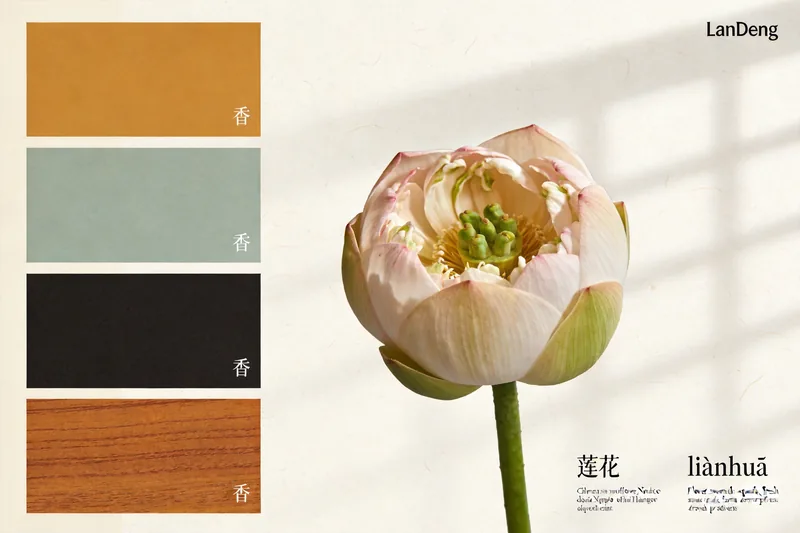
Technical answer: Lotus flower — liánhuā (莲花, also 荷花 héhuā) in Chinese — is the blossom of Nelumbo nucifera, the sacred lotus, an aquatic perennial of the Nelumbonaceae family native to Asia. In Chinese incense it is a symbol first, a material second: the flower’s own scent is too delicate to survive burning, so classical incense built a “lotus” accord from woods and herbs, and only later manuals used the actual flower. True lotus is Nelumbo nucifera — not the water lily.
Key facts
| Chinese | 莲花 (liánhuā), also 荷花 (héhuā) |
| Botanical source | Nelumbo nucifera (family Nelumbonaceae) — the flower |
| What it is | An aquatic flowering plant, not a wood or resin |
| Aroma | Delicate, fresh, sweet, aquatic (subtle) |
| Traditional role | Symbol of purity; fresh-floral accord or real material |
Aroma profile
True lotus flower has a subtle, fresh, sweet, mildly aquatic scent that is too delicate to survive combustion. This is the key fact about lotus in incense: what carries a “lotus” note in most blends is a floral accord — a fresh, clean impression assembled from woods, herbs, and spices — rather than the flower itself. The real flower sits at the uplifting, fresh-floral end of the spectrum, the opposite of heavy woods and resins.
Botanical source and origin
Nelumbo nucifera is an aquatic perennial of the Nelumbonaceae family, native to Asia and cultivated across warm regions worldwide. It is a single-species family, and it is frequently confused with the water lily (Nymphaea), which belongs to a different family (Nymphaeaceae). The distinction matters: “blue lotus” is a water lily, not a true lotus. The name Nelumbo nucifera derives from a Sinhalese name for the plant plus the Latin nucifera (“nut-bearing”).
A naming caution: true lotus = Nelumbo nucifera (Nelumbonaceae); water lily = Nymphaea (Nymphaeaceae). They are different plants, and “blue lotus” (Nymphaea caerulea) is a water lily, not a lotus.
In Chinese tradition
- Symbol of purity: 莲花 carries deep symbolism — 出淤泥而不染, “emerges from the mud unstained” — more than a classical incense material. It is the Buddhist lotus throne and a mark of purity.
- The lotus accord: classical incense built a “lotus” scent without the flower. The 香乘’s 芙药衣香 (lotus clothes incense) is assembled entirely from clove, sandalwood, spikenard, tonka, peony bark, and fennel — explicitly described as smelling “like a freshly opened lotus” (其香如新开莲花) — with no lotus in it at all.
- Real-material lotus: later and contemporary manuals use the actual flower. The 燕居香语 (Yànjū Xiāngyǔ) pairs fresh lotus petals with saffron, agarwood, and dendrobium.
Traditional use vs modern evidence
The botanical identity and the cultural symbolism are well documented. This page makes no therapeutic or spiritual-power claims — it treats lotus as a botanical and cultural material. The documented, non-medical facts are botanical identity, the lotus-vs-water-lily distinction, and the “accord vs real flower” history.
Quality and sourcing notes
Practical points:
- Most commercial “lotus” incense is a floral accord, not real lotus, because true lotus absolute is rare and costly and the flower’s scent does not survive burning.
- Distinguish lotus (Nelumbo) from water lily (Nymphaea) — “blue lotus” is a different plant.
- In classical terms, “lotus” is more often an idea (purity, lift) than an ingredient.
Safety
Incense combustion produces smoke and particulate matter. Burn in a well-ventilated space, avoid inhaling concentrated smoke, and keep away from children and pets. This is editorial knowledge content, not medical advice.
FAQ
Is lotus incense made from real lotus flowers? Usually not. True lotus flower has a scent too delicate to survive burning, and true lotus absolute is rare and costly. Most “lotus” incense is a floral accord — a fresh, clean floral impression built from woods, herbs, and spices — rather than the actual flower. Only later and contemporary manuals use real lotus material, and even the classical 香乘 built its lotus clothes-incense without the flower. See the lotus incense recipe.
What is the difference between lotus and water lily? They are different plant families. True lotus is Nelumbo nucifera (Nelumbonaceae), an aquatic plant with a distinctive seed pod; water lily is Nymphaea (Nymphaeaceae). “Blue lotus” is actually a water lily, Nymphaea caerulea, not a lotus. The distinction matters for labeling and identity, and it is a common mix-up even among enthusiasts.
What does lotus smell like? Delicate, fresh, and mildly sweet, with a subtle aquatic quality. It sits at the uplifting, fresh-floral end of the scent spectrum — the opposite of heavy woods and resins. Because the real flower’s scent is too delicate to survive burning, the “lotus” note in incense is usually an accord assembled from fresher, cleaner materials over a sandalwood base.
Why is lotus a symbol more than an ingredient in Chinese incense? Because the lotus flower is above all a symbol of purity — 出淤泥而不染, “emerges from the mud unstained” — and the Buddhist lotus throne. In classical incense, what mattered was the idea of unstained purity, not the flower’s chemistry. The tradition could therefore produce a “lotus” scent without any lotus at all, by layering fresh, clean notes over a sandalwood base.
What part of the lotus plant is used? The flower (petals), but also, in broader tradition, the seed, the root (rhizome, 莲藕), the leaf, and the seed pod — nearly every part of Nelumbo nucifera has a use. In incense specifically, it is the flower that matters, whether as a real material (petals) or as the accord that evokes it. The flower’s own scent is the most delicate part, which is why it is usually evoked rather than burned.
See also: plum-blossom, osmanthus, the lotus incense recipe, and the full scent guide.
Evidence & Sources
Botanical identity
Source: Nelumbo nucifera in Flora of China · Nelumbo nucifera on GBIF. Evidence type: Established.
Traditional Chinese use
Source: 香乘 芙药衣香 lotus clothes-incense built without the flower (“其香如新开莲花”); 莲花 in the 本草綱目 果部; the 燕居香语 contemporary real-lotus formula. Evidence type: Historically documented — cultural symbolism; no therapeutic claims.
Authenticity / disambiguation
Source: Nelumbo nucifera (lotus) vs Nymphaea (water lily) — different families; “blue lotus” is a water lily. Evidence type: Practical screening.
Safety
Source: incense combustion produces smoke and particulate matter; burn in a well-ventilated space. Evidence type: Established.
Evidence status
| Layer | Status |
|---|---|
| Botanical identity | Established |
| Traditional use | Historically documented (cultural) |
| Authenticity test | Practical screening |
| Health claims | Not established |
Sources
Sources: botanical references on Nelumbo nucifera and the lotus-vs-water-lily distinction. Lotus is documented as a cultural symbol and a delicate floral material. This page makes no therapeutic or spiritual-power claims. This is editorial knowledge content, not medical advice.