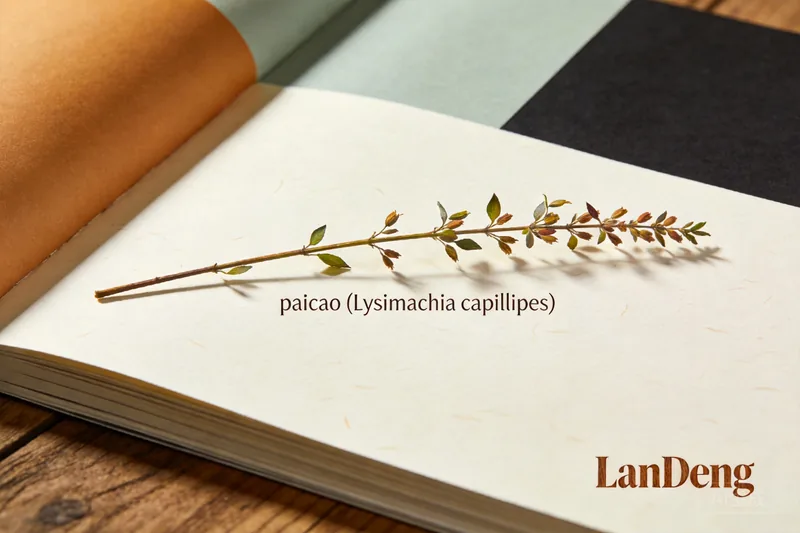
Technical answer: Paicao — páicǎo (排草) in Chinese — is the dried whole herb of Lysimachia capillipes, a small perennial of the primrose family (Primulaceae) native to southern China. It is an aromatic herb with a sweet, hay-like, faintly woody scent, used in Chinese incense as a supporting herbal note in 合香 (blended incense) and as a scenting herb. It belongs to the same genus as the better-known 零陵香 (linglingxiang), Lysimachia foenum-graecum.
Key facts
| Chinese | 排草 (páicǎo), also 排香草 |
| Botanical source | Lysimachia capillipes (family Primulaceae) — the dried whole herb |
| What it is | A dried aromatic herb, not a wood or resin |
| Aroma | Herbal, sweet, hay-like, faintly woody |
| Traditional role | 合香 supporting herb; scenting material |
Aroma profile
Paicao is herbal and sweet, with a hay-like, faintly woody character typical of the Lysimachia aromatic herbs — a fresh, green-sweet scent that recalls coumarin-tonka notes without being heavy. It is a supporting herb: it fills the herbal register of a blend, supporting and softening brighter or spicier ingredients, rather than leading with its own strong note.
Botanical source and origin
Lysimachia capillipes is a small perennial herb of the primrose family (Primulaceae), native to southern China. The part used is the dried whole herb, gathered and dried for its aromatic character. The genus Lysimachia groups several aromatic herbs used in Chinese incense and materia medica — most famously 零陵香 (Lysimachia foenum-graecum), a closely related species with a similar hay-sweet profile.
A naming caution: 排草 (Lysimachia capillipes) and 零陵香 (Lysimachia foenum-graecum) are closely related species of the same genus, both aromatic Lysimachia herbs — but they are distinct materials, and 零陵香 has its own entry. The shared sweet, hay-like character reflects their common genus, not the same plant.
In Chinese tradition
- 合香 (blended incense): 排草 is a supporting aromatic herb in classical 合香 formulas, contributing a sweet, hay-like body beneath woods and resins.
- Scenting herb: the whole herb is used as a scenting material for garments and spaces, in the same tradition as other aromatic herbs.
- Materia medica: 排草 is recorded in traditional Chinese medicine (本草綱目, 草部). This is traditional materia-medica language, not modern clinical evidence.
Traditional use vs modern evidence
The aromatic use is documented in classical records. Medicinal uses are traditional, not established clinical fact, and we make no medical claims. The documented, non-medical facts are botanical identity, the Lysimachia genus placement, and the sweet, hay-like aromatic use.
Quality and sourcing notes
Practical points for buyers:
- Paicao should be clean, dry, and fragrant with a sweet, hay-like scent when gently warmed.
- Distinguish 排草 (Lysimachia capillipes) from 零陵香 (Lysimachia foenum-graecum) — closely related but distinct herbs.
- In incense, paicao is a supporting herb, usually blended, not burned alone.
Safety
Incense combustion produces smoke and particulate matter. Burn in a well-ventilated space, avoid inhaling concentrated smoke, and keep away from children and pets. This is editorial knowledge content, not medical advice.
FAQ
What is 排草 (paicao)? The dried whole herb of Lysimachia capillipes, a small perennial of the primrose family (Primulaceae) native to southern China. It is an aromatic herb with a sweet, hay-like, faintly woody scent, used in Chinese incense as a supporting herbal note in 合香 (blended incense). It is closely related to 零陵香 (Lysimachia foenum-graecum).
How does paicao relate to 零陵香 (linglingxiang)? They are closely related species of the same genus, Lysimachia — paicao is L. capillipes, and 零陵香 is L. foenum-graecum. Both are aromatic herbs with a sweet, hay-like, faintly woody character, reflecting their common genus, but they are distinct materials, and 零陵香 has its own entry in this encyclopedia.
What does paicao smell like? Herbal and sweet, with a hay-like, faintly woody character — a fresh, green-sweet scent that recalls coumarin-tonka notes without being heavy. It is a supporting herb that fills the herbal register of a blend, softening brighter or spicier ingredients rather than leading with its own strong note.
What part of the plant is used? The dried whole herb — the aerial parts of Lysimachia capillipes — gathered and dried for its aromatic character. It is used as a supporting herb in blended incense and as a scenting material for garments and spaces, in the same tradition as other aromatic herbs.
Where does paicao come from? From Lysimachia capillipes, a small perennial herb of the primrose family native to southern China. The genus Lysimachia groups several aromatic herbs used in Chinese incense and materia medica, and paicao is the species that appears as a supporting sweet herb in some 合香 formulas.
See also: linglingxiang, agastache-rugosa, and the full scent guide.
Evidence & Sources
Botanical identity
Source: Lysimachia capillipes in Flora of China · Lysimachia capillipes on GBIF. Evidence type: Established.
Traditional Chinese use
Source: 排草 as a 合香 supporting herb and scenting material, recorded in the 本草綱目 草部. Evidence type: Historically documented — aromatic use; medicinal uses are traditional, not modern clinical evidence.
Authenticity / disambiguation
Source: 排草 (Lysimachia capillipes) vs 零陵香 (Lysimachia foenum-graecum) — closely related but distinct Lysimachia herbs. Evidence type: Practical screening.
Safety
Source: incense combustion produces smoke and particulate matter; burn in a well-ventilated space. Evidence type: Established.
Evidence status
| Layer | Status |
|---|---|
| Botanical identity | Established |
| Traditional use | Historically documented |
| Authenticity test | Practical screening |
| Health claims | Not established |
Sources
Sources: botanical references on Lysimachia capillipes and the paicao-vs-linglingxiang distinction. Paicao is recorded as an aromatic herb; medicinal uses are treated as traditional, not established clinical fact. This is editorial knowledge content, not medical advice.