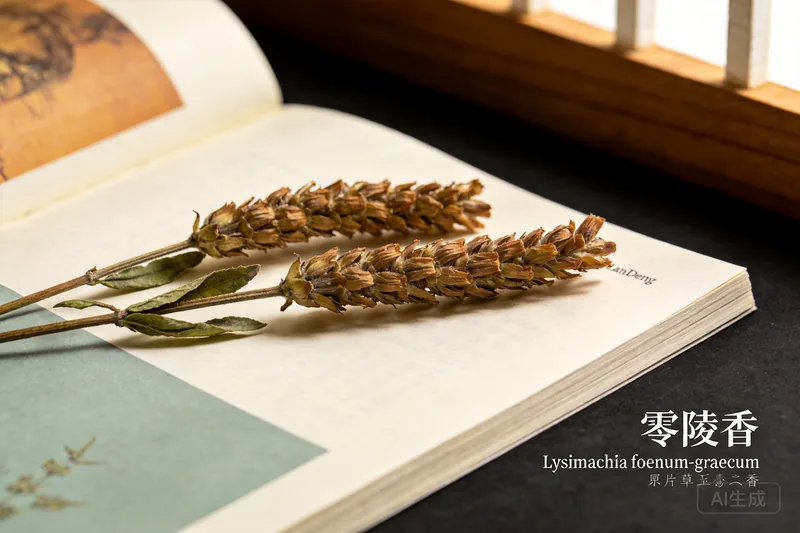
Technical answer: Linglingxiang — línglíngxiāng (零陵香) in Chinese — is a fragrant herb identified today as Lysimachia foenum-graecum, a moisture-loving plant of southern China whose dried herb smells sweet and hay-like. It is a classical Chinese incense herb, though its historical identity is tangled: the same name (and its alias 熏草) has been applied across several aromatic herbs over the centuries.
Key facts
| Chinese | 零陵香 (línglíngxiāng); classical aliases 熏草 / 蕙草 / 燕草 |
| Botanical source | Lysimachia foenum-graecum (family Primulaceae) — the dried herb |
| What it is | A dried aromatic herb, not a wood or resin |
| Aroma | Sweet, hay-like, herbaceous, with a coumarin note |
| Traditional role | 合香 (blended incense), scenting, classical materia medica |
Aroma profile
零陵香 smells sweet and hay-like, with a coumarin note — closer to sweet grass or tonka than to a flower or a pungent herb. The name is literal in a botanical sense: the species epithet foenum-graecum means “Greek hay,” a reference to the plant’s sweet-hay fragrance. It reads as a soft, sweet-green note that blends smoothly rather than standing alone.
A name with a tangled history
零陵香 is the classic example of a name that has drifted. The earliest references describe a plant called 熏草 (“fumigating herb”), said to have hemp-like leaves and a square stem, growing in the 零陵 valley — hence 零陵香. Over the centuries the same name, and its aliases (熏草, 蕙草, 燕草, 黄零草), were applied to several different aromatic herbs:
- 零陵香 (modern identification): Lysimachia foenum-graecum, the sweet-hay herb, a Primulaceae plant of wet southern-China habitats.
- 佩兰 / 都梁香 (historical conflation): Eupatorium fortunei (and related orchid-herb allies), a different aromatic herb that some classical sources treated as the same thing.
The Song-dynasty Xiangpu (香譜) itself notes this confusion — 古今采用自殊其类各别 — acknowledging that “what was used then and now differ in kind.” For this site, 零陵香 is Lysimachia foenum-graecum, with the historical aliases noted as such.
In Chinese tradition
- 合香 (blended incense): 零陵香 is a classical sweet-herb ingredient in blended incense, contributing a soft, hay-sweet note. It appears alongside 甘松, 藿香, 檀香, and 白芷 in standard formulas.
- Scenting: classical texts describe it for scenting clothes and as a fragrant herb in its own right.
- Materia medica: 零陵香 appears in traditional Chinese medicine, described in the Xiangpu’s sources for “stopping pestilential qi” (可以止疠) and related uses. This is traditional materia-medica language, not modern clinical evidence.
Traditional use vs modern evidence
The classical record is rich but botanical identity is genuinely uncertain across sources, and the medicinal descriptions are traditional, not established clinical fact. We make no medical claims. The well-documented facts are: 零陵香 is a sweet, hay-like aromatic herb used in classical Chinese incense, and its historical name has been applied to more than one plant.
Quality and sourcing notes
Because the name has drifted, buyers should expect ambiguity:
- Modern 零陵香 is Lysimachia foenum-graecum (灵香草), a sweet-hay-scented herb.
- The same name historically covered 佩兰 (Eupatorium fortunei) and the 都梁香 group — different plants with different scents.
- A label that says only “零陵香” or “熏草” may not specify the species, so the material’s actual identity is worth confirming.
Safety
Incense combustion produces smoke and particulate matter. Burn in a well-ventilated space, avoid inhaling concentrated smoke, and keep away from children and pets. This is editorial knowledge content, not medical advice.
FAQ
What does 零陵香 smell like? 零陵香 smells sweet and hay-like, with a coumarin note — closer to sweet grass or tonka than to a flower or a pungent herb. The species name foenum-graecum literally means “Greek hay,” a nod to that sweet-hay fragrance. It is a soft, sweet-green note that blends smoothly in incense rather than leading with a sharp or heavy character.
Why is 零陵香’s identity confusing? Because the name has drifted across centuries. The earliest references describe 熏草 (“fumigating herb”), said to have hemp-like leaves and a square stem, growing in the 零陵 valley. Over time the name 零陵香 and its aliases (熏草, 蕙草, 燕草) were applied to several aromatic herbs — chiefly Lysimachia foenum-graecum (the modern identification) and Eupatorium fortunei (佩兰 / 都梁香). The Song-dynasty Xiangpu (香譜) itself notes the confusion.
Is 零陵香 the same as 佩兰? They are different plants that have been historically conflated. 零陵香 is identified today as Lysimachia foenum-graecum, a sweet-hay-scented Primulaceae herb; 佩兰 is Eupatorium fortunei, a different aromatic herb in the aster family. The name 零陵香 (and the alias 熏草) has covered both across different eras, which is why the two are often treated as the same in older texts.
How is 零陵香 used in incense? It is a classical sweet-herb ingredient in 合香 (blended incense), contributing a soft, hay-sweet note. It appears in standard formulas alongside 甘松, 藿香, 檀香, and 白芷, and was also used for scenting clothes. It is a blender — its sweet-green character supports a formula rather than carrying one alone.
What part of the plant is used? The dried herb — the leafy aerial part of Lysimachia foenum-graecum — is the part used. The plant is moisture-loving, found in wet habitats of southern China, and the dried herb is what carries the sweet-hay fragrance. This distinguishes it from root materials (like 甘松 or 香附子) and from woods and resins.
See also: patchouli, agastache, and the full scent guide.
Evidence & Sources
Botanical identity
Source: Lysimachia foenum-graecum in Flora of China · Lysimachia foenum-graecum on GBIF. Evidence type: Established (modern identification); historical identity is disputed across sources.
Traditional Chinese use
Source: the Song-dynasty Xiangpu (香譜) records 零陵香 (卷二, citing 《南越志》 and 《山海經》) under aliases 熏草 / 燕草; the Ming Xiangcheng (香乘) lists further aliases 蕙草 / 香草 / 黄零草. Evidence type: Historically documented — traditional, not modern clinical evidence. Note: historical identity confusion with 佩兰 (Eupatorium fortunei) / 都梁香.
Authenticity / disambiguation
Source: the 零陵香 (Lysimachia foenum-graecum) vs 佩兰 (Eupatorium fortunei) vs 都梁香 historical conflation. Evidence type: Practical screening.
Safety
Source: incense combustion produces smoke and particulate matter; burn in a well-ventilated space. Evidence type: Established.
Evidence status
| Layer | Status |
|---|---|
| Botanical identity | Established (modern); disputed historically |
| Traditional use | Historically documented |
| Authenticity test | Practical screening |
| Health claims | Not established |
Sources
Sources: botanical references on Lysimachia foenum-graecum and the Song-dynasty Xiangpu (香譜) / Ming Xiangcheng (香乘) records of 零陵香. The 零陵香 / 佩兰 / 都梁香 historical conflation is recorded as such. Medicinal uses are treated as traditional, not established clinical fact. This is editorial knowledge content, not medical advice.