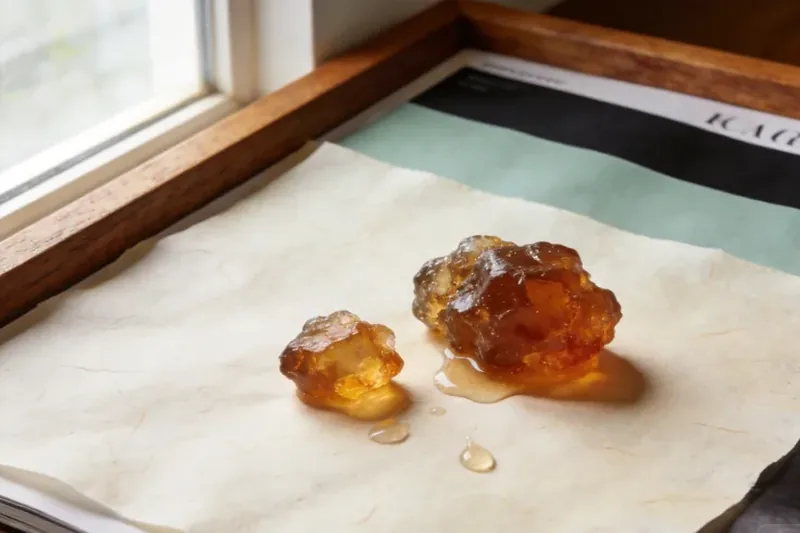
Direct answer: Peru balsam (秘鲁香脂, bìlǔ xiāngzhī) is an aromatic resin from the tree Myroxylon balsamum, a legume (Fabaceae) native to Central America. It is a sweet, vanilla-like, balsamic resin used in Western perfumery as a fixative and sweetener. It enters Chinese fragrance as a modern crossover — it has no classical Chinese incense origin, and none is claimed.
Key facts
| Chinese | 秘鲁香脂 (bìlǔ xiāngzhī) — “Peru balsam” |
| Botanical source | Myroxylon balsamum (family Fabaceae) — the resin |
| What it is | A sweet, vanilla-like balsamic resin |
| Aroma | Sweet, vanilla, balsamic, warm |
| Traditional role | None in classical Chinese incense; modern perfumery resin |
Aroma profile
Peru balsam is deeply sweet and warm, with a rich vanilla-cinnamon balsamic character and a soft, resinous depth. It is a classic Western perfumery base note and fixative, prized for anchoring sweeter compositions and lending a gourmand, almost caramel warmth. This Western profile — not any Chinese classical record — is what brings 秘鲁香脂 into modern Chinese fragrance, where it overlaps with resins like 安息香 (benzoin).
A provenance note (read this)
秘鲁香脂 is a modern crossover, not a classical Chinese incense material:
- The tree Myroxylon balsamum is native to Central America, and the resin entered global trade through Western perfumery and pharmacy.
- The name 秘鲁香脂 (“Peru balsam”) is a geographic label — the resin’s name in trade — not a term from 香乘 (Xiang Cheng) or the Bencao Gangmu (本草纲目).
- It does not appear in the classical 香材 canon; its Chinese use is modern perfumery and fragrance.
This page records it honestly as a modern resin — no classical Chinese origin is claimed, and none is fabricated.
Botanical source and origin
Myroxylon balsamum is a leguminous tree (Fabaceae) native to Central America, whose aromatic resin — Peru balsam — is collected by tapping and is prized for its sweet, vanilla-like warmth. Despite the name, the resin is not from Peru in its native origin (it was long shipped via Peruvian ports, giving the trade name). It has no Flora of China entry, being a New World species grown in China only as an exotic.
In modern use
- Perfumery: Peru balsam is a classic sweet base note and fixative, used to anchor and warm fragrances.
- Fragrance crossover: it appears in modern Chinese perfumery as a sweet, balsamic resin alongside 安息香 (benzoin) and 苏合香 (storax).
- Not a classical incense material: it has no role in 合香 (blended incense) or the classical 香材 canon.
Traditional use vs modern evidence
There is no classical Chinese incense record for 秘鲁香脂; its position is entirely modern. We make no medical claims. The documented facts are botanical identity, the Fabaceae placement, and the resin’s modern perfumery role.
Quality and sourcing notes
Practical points for buyers:
- 秘鲁香脂 is Peru balsam, the resin of Myroxylon balsamiferum — now treated as Myroxylon balsamum; expect a sweet, vanilla-like, balsamic warmth.
- It is a modern perfumery resin, not a classical 香材, and not a burned incense ingredient in the Chinese tradition.
- It can be a contact sensitizer in some individuals — a documented perfumery safety note, not a fragrance virtue.
Safety
Incense combustion produces smoke and particulate matter. Burn in a well-ventilated space, avoid inhaling concentrated smoke, and keep away from children and pets. Peru balsam is a known contact sensitizer for some people. This is editorial knowledge content, not medical advice.
FAQ
What is 秘鲁香脂 (Peru balsam)? An aromatic resin from the tree Myroxylon balsamum, a legume (Fabaceae) native to Central America. It is sweet, vanilla-like, and balsamic, and it is used in Western perfumery as a base note and fixative. Its name is a trade label, not a Chinese classical term.
Is 秘鲁香脂 a classical Chinese incense ingredient? No. The tree is native to Central America, and the resin entered Chinese use through modern perfumery. It does not appear in the 香乘 (Xiang Cheng) or the Bencao Gangmu (本草纲目), and the name 秘鲁香脂 is a geographic trade label. Its position is a modern crossover resin, and no classical origin is claimed.
Why is it called “Peru” balsam if the tree is from Central America? The name is a trade artifact, not a botanical origin. The resin was historically shipped through Peruvian ports, giving the material its commercial name “Peru balsam,” even though the tree Myroxylon balsamum is native to Central America. The name stuck in trade and persists today.
What does Peru balsam smell like? Deeply sweet and warm, with a rich vanilla-cinnamon balsamic character and a soft, resinous depth. It is a classic base note and fixative in Western perfumery, prized for anchoring sweeter compositions and lending a gourmand, almost caramel warmth.
How does Peru balsam relate to benzoin and storax? They are all sweet, balsamic resins used as fixatives, but from different plants. Peru balsam is Myroxylon balsamum (Fabaceae), benzoin (安息香) is Styrax resin, and storax (苏合香) is Liquidambar orientalis. They overlap in warm, sweet, vanilla-balsamic character but differ in botanical source and precise scent.
See also: benzoin, storax, vanilla, copaiba and the full scent guide.
Evidence & Sources
Botanical identity
Source: Myroxylon balsamum on GBIF. Evidence type: Established.
Modern use
Source: Peru balsam as a Western perfumery base note and fixative, and a modern Chinese fragrance crossover. Evidence type: Modern perfumery — no classical Chinese record; none claimed.
Authenticity / provenance
Source: 秘鲁香脂 is a modern crossover (Central American origin, Fabaceae); it is not in the classical 香材 canon. Evidence type: Practical screening.
Safety
Source: incense combustion produces smoke and particulate matter; Peru balsam is a known contact sensitizer. Evidence type: Established.
Evidence status
| Layer | Status |
|---|---|
| Botanical identity | Established |
| Traditional use | None (modern crossover) |
| Authenticity test | Practical screening |
| Health claims | Not established |
Sources
Sources: botanical references on Myroxylon balsamum. 秘鲁香脂 is a modern crossover resin with no classical Chinese incense record; no such origin is claimed. This is editorial knowledge content, not medical advice.