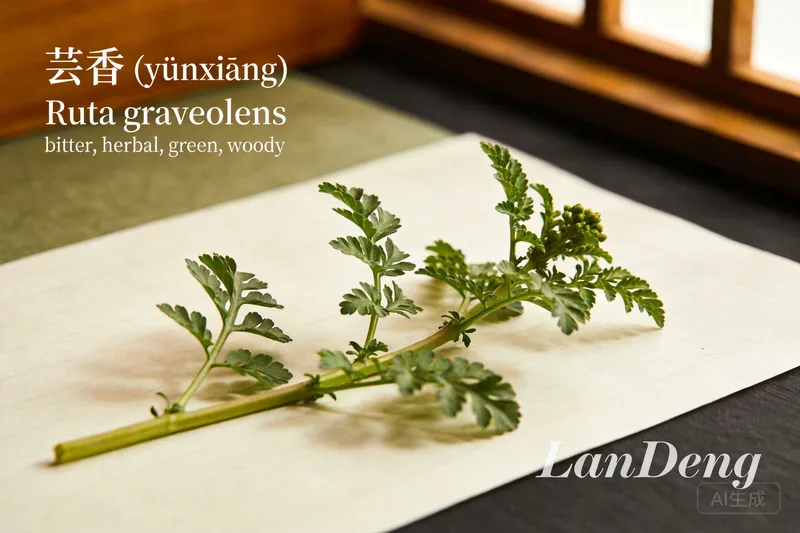
Technical answer: Rue — yúnxiāng (芸香) in Chinese — is the dried leafy herb of Ruta graveolens, a small evergreen shrub of the rue family (Rutaceae) native to the Mediterranean and western Asia, long cultivated in China. It is a strongly bitter, herbaceous aromatic with a green, faintly woody, penetrating scent, used in Chinese incense and as a scenting and book-preserving herb. Its name in Chinese is also applied to a group of aromatic “book herbs.”
Key facts
| Chinese | 芸香 (yúnxiāng) |
| Botanical source | Ruta graveolens (family Rutaceae) — the dried herb |
| What it is | A dried aromatic herb, not a wood or resin |
| Aroma | Bitter, herbaceous, green, faintly woody |
| Traditional role | Scenting herb, incense accent, book-preserving herb |
Aroma profile
Rue is strongly bitter and herbaceous, with a green, faintly woody, penetrating scent that is unmistakably sharp — often described as acrid or medicinal to modern noses. It is a powerful accent rather than a pleasant base: a little goes a long way, and it is valued more for its intense, protective, “green” character than for sweetness. This intensity is why it is blended sparingly, not burned alone.
Botanical source and origin
Ruta graveolens is a small evergreen shrub of the rue family (Rutaceae), native to the Mediterranean and western Asia, and long cultivated as an aromatic and ornamental across Europe and China. The part used is the dried leafy herb. In Chinese, 芸香 has a broad application: it names rue, and it is also used for a group of aromatic herbs placed among books to repel insects — the “book herb” tradition that gives a library its classical name (芸阁 / 芸台).
A naming caution: 芸香 primarily names rue (Ruta graveolens), but in Chinese it also carries a broad sense as an aromatic “book herb” placed among books to deter insects. The two senses are related — both are strong, protective green aromatics — but a label that says only 芸香 should be read with the herb context in mind.
In Chinese tradition
- Scenting and book herb: 芸香 is the classical “book herb,” placed among books and scrolls for its strong aromatic and insect-repelling character; a library or study is poetically called 芸阁 or 芸台.
- Incense accent: rue appears as a powerful, bitter-green accent in some 合香 blends, used sparingly for its penetrating character.
- Materia medica: 芸香 is recorded in traditional Chinese medicine (本草綱目, 木部) with various described uses. This is traditional materia-medica language, not modern clinical evidence.
Traditional use vs modern evidence
The scenting and book-herb uses are well documented. Medicinal uses are traditional, not established clinical fact, and we make no medical claims. The documented, non-medical facts are botanical identity, the book-herb tradition, and the bitter-green aromatic use.
Quality and sourcing notes
Practical points for buyers:
- Dried rue should be green, intensely aromatic, and bitter-herbaceous; its strength fades with age.
- Note rue’s intensity — it is a powerful accent, blended sparingly, not a pleasant base.
- Rue (Ruta graveolens) can cause skin irritation on contact in some people; handle with care and keep away from children and pets.
Safety
Incense combustion produces smoke and particulate matter. Burn in a well-ventilated space, avoid inhaling concentrated smoke, and keep away from children and pets. Rue herb can irritate skin on contact in some people. This is editorial knowledge content, not medical advice.
FAQ
What is rue (芸香)? The dried leafy herb of Ruta graveolens, a small evergreen shrub of the rue family (Rutaceae) native to the Mediterranean and western Asia, long cultivated in China. It is a strongly bitter, herbaceous aromatic with a green, faintly woody, penetrating scent, used in incense and as a scenting and book-preserving herb.
Why is rue associated with books? Because 芸香 is the classical “book herb” — its strong aromatic and insect-repelling character led people to place it among books and scrolls to protect them, and a library or study is poetically called 芸阁 or 芸台 in Chinese. The association is cultural and long-standing, tied to the herb’s intensity rather than any fragrance sweetness.
What does rue smell like? Strongly bitter and herbaceous, with a green, faintly woody, penetrating scent that is unmistakably sharp — often described as acrid or medicinal to modern noses. It is a powerful accent rather than a pleasant base: a little goes a long way, and it is blended sparingly rather than burned alone.
Is rue safe to handle? Rue herb (Ruta graveolens) can irritate the skin on contact in some people, especially in sunlight, so it should be handled with care and kept away from children and pets. This is a handling caution, not a claim about its incense use. When burned, the usual incense-combustion cautions apply — burn in a well-ventilated space and avoid inhaling concentrated smoke.
Where does rue come from? From Ruta graveolens, a small evergreen shrub of the rue family native to the Mediterranean and western Asia, and long cultivated as an aromatic and ornamental across Europe and China. The dried leafy herb is the part used. In Chinese the name 芸香 also carries a broader sense as an aromatic “book herb,” reflecting its classical use among books and scrolls.
See also: mugwort, citronella, and the full scent guide.
Evidence & Sources
Botanical identity
Source: Ruta graveolens on GBIF. Evidence type: Established.
Traditional Chinese use
Source: 芸香 as the classical “book herb” (芸阁 / 芸台) and a scenting/incense herb, recorded in the 本草綱目 木部 and the 香乘 (Xiang Cheng). Evidence type: Historically documented — cultural and aromatic use; medicinal uses are traditional, not modern clinical evidence.
Authenticity / disambiguation
Source: 芸香 as rue (Ruta graveolens) vs the broader “book herb” sense of the name. Evidence type: Practical screening.
Safety
Source: incense combustion produces smoke and particulate matter; rue can irritate skin on contact in some people. Evidence type: Established.
Evidence status
| Layer | Status |
|---|---|
| Botanical identity | Established |
| Traditional use | Historically documented (cultural) |
| Authenticity test | Practical screening |
| Health claims | Not established |
Sources
Sources: botanical references on Ruta graveolens and the 芸香 book-herb tradition. Rue is recorded as a scenting and incense herb; medicinal uses are treated as traditional, not established clinical fact. This is editorial knowledge content, not medical advice.