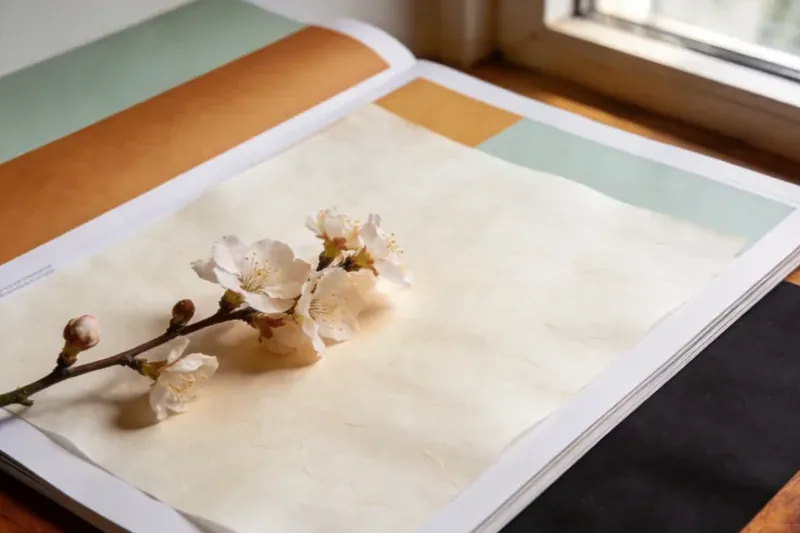
Direct answer: Yulan magnolia (玉兰, yùlán) is the flower of Magnolia denudata, a deciduous tree of the magnolia family (Magnoliaceae) native to central and eastern China. Its large, white, fragrant spring flowers are a celebrated symbol of early spring, and the flower is used in Chinese incense and fragrance as a fresh white-floral note. It is closely related to, and easily confused with, 辛夷 (the dried magnolia flower bud, Magnolia biondii).
Key facts
| Chinese | 玉兰 (yùlán) — “jade orchid”; also 白玉兰 |
| Botanical source | Magnolia denudata (family Magnoliaceae; Flora of China: Yulania denudata) — the flowers |
| What it is | A flower, not a wood or resin |
| Aroma | Floral, fresh, green, slightly lemony |
| Traditional role | Fresh white-floral note; spring symbol |
Aroma profile
Direct answer: 玉兰 is a fresh, clear white floral with a green, slightly lemony brightness and none of the heavy indole of jasmine or the spicy camphor of its bud counterpart 辛夷. It is lighter and more “open” than a bud — a clean spring-flower character that lifts rather than deepens. In a blend it works as a fresh floral top note.
玉兰 is a fresh, clear white floral with a green, slightly lemony brightness and none of the heavy indole of jasmine or the spicy camphor of its bud counterpart 辛夷. It is lighter and more “open” than a bud — a clean spring-flower character that lifts rather than deepens. In a blend it works as a fresh floral top note, closer in spirit to a light magnolia or a delicate white flower than to an opulent blossom.
Botanical identity
Direct answer: Magnolia denudata is a deciduous tree of the magnolia family (Magnoliaceae). Flora of China describes a tree to 25 m tall whose large flowers — 10–16 cm across, with nine white tepals usually pinkish at the base — open on bare branches in late winter and early spring, before the leaves. It is grown as an ornamental and for timber and is widely cultivated in temperate parts of the world.
Flora of China describes Magnolia denudata precisely: trees to 25 m tall, to 1 m in trunk diameter, with bark that is deep gray and coarsely fissured; leaf blades obovate to broadly obovate, 10–15(−18) cm; flowers appearing before the leaves, 10–16 cm across, erect and fragrant, with nine white tepals, oblong-obovate, usually pinkish at the base; flowering February–March, fruiting August–September. It grows in forests at 500–1,000 m in Anhui, Chongqing, northern Guangdong, Guizhou, Hubei, Hunan, Jiangxi, Shaanxi, Yunnan, and Zhejiang, and is “grown as an ornamental and for timber,” “widely cultivated in temperate parts of the world.” Flora of China places it in the segregate genus Yulania as Yulania denudata; GBIF accepts Magnolia denudata. See Yulania denudata in Flora of China and Magnolia denudata on GBIF.
Chinese name and terminology
Direct answer: The name 玉兰 means “jade orchid” — 玉 (jade) for the white flowers, 兰 (orchid) by the same loose Chinese convention that names many fragrant plants “兰” without implying an orchid species. The name is ornamental in origin, and the flower has no classical 香乘 term — its documented classical role is as a garden tree and spring symbol.
The name 玉兰 means “jade orchid”: 玉 (jade) for the white flowers, 兰 (orchid) by the loose Chinese convention that applies 兰 to many fragrant plants without implying a botanical orchid. It is distinct from the bud material 辛夷, which has its own classical term:
- 玉兰 (yulan) — Magnolia denudata, the open white flower. This entry.
- 辛夷 (xinyi) — Magnolia biondii (and relatives), the dried, unopened bud, spicy and camphoraceous. Its own entry (see magnolia-flower).
The line is further blurred because 辛夷 may in practice be sourced from the buds of related magnolias including M. denudata. This page describes 玉兰 = Magnolia denudata.
The 玉兰 / 辛夷 distinction (read this)
Direct answer: Two magnolia-family materials share the “magnolia” name but differ in species and, crucially, plant part: 玉兰 is the open white flower of Magnolia denudata, while 辛夷 is the dried, unopened bud of Magnolia biondii and relatives. Flower vs bud is the key distinction — an open flower is fresh and green-lemony, while a closed bud is spicy and camphoraceous.
The distinction is real and worth pinning down:
- 玉兰 (Magnolia denudata) — the open white flower; fresh, green, slightly lemony. This entry.
- 辛夷 (Magnolia biondii, Flora of China Yulania biondii) — the dried, unopened bud; spicy and camphoraceous. Its own entry.
The practical point is that flower and bud are different materials from different (though related) species, with different aromas: an open flower reads fresh and green-lemony, while a closed bud reads spicy and camphoraceous. A buyer should not treat “magnolia” as one material; the plant part — flower vs bud — is the specification.
Where does yulan magnolia come from?
Direct answer: Magnolia denudata is native to central and eastern China — Anhui, Chongqing, northern Guangdong, Guizhou, Hubei, Hunan, Jiangxi, Shaanxi, Yunnan, and Zhejiang — and is now widely cultivated in temperate parts of the world as an ornamental and timber tree. Its flowers open on bare branches in late winter and early spring.
Magnolia denudata is native to central and eastern China — Anhui, Chongqing, northern Guangdong, Guizhou, Hubei, Hunan, Jiangxi, Shaanxi, Yunnan, and Zhejiang — in forests at 500–1,000 m, and is now widely cultivated across temperate regions as an ornamental and timber tree. Its large white flowers open on bare branches in late winter and early spring, before the leaves, which is the source of its classical association with the season’s arrival. This ornamental, widely-cultivated status is part of its identity: it is a garden tree and spring symbol as much as an aromatic.
Why is it used in incense and fragrance?
Direct answer: 玉兰 is used as a fresh white-floral note — a light, green-lemony lift in incense and scenting. It is not a 香乘 canon ingredient; its documented classical role is ornamental and cultural, so its incense use is a lighter, modern floral application rather than a 香道 heritage material.
玉兰’s role in incense and fragrance is as a fresh white-floral note: a light, green-lemony lift used in blending and scenting. It is not a 香乘 (Xiang Cheng) canon ingredient — its documented classical role is ornamental and cultural — so its incense use is best understood as a lighter, modern floral application. A buyer should position it as a fresh floral top note, not a deep or canonical 香材.
How is it processed?
Direct answer: 玉兰 is a flower, handled by careful drying to preserve its fresh, green-lemony white-floral note. The flower is delicate and the note is volatile, so gentle, low-temperature drying is the practical concern; the open flower is the material, distinguishing it from the closed bud (辛夷) that is dried unopened.
As a flower, 玉兰 is handled by drying — carefully, because the fresh white-floral note is delicate and volatile. Gentle, low-temperature drying preserves the green-lemony character; harsh or prolonged heat flattens it. The open flower is the material of use, which is exactly the distinction from 辛夷: the bud is dried unopened (which concentrates its spicy camphor), while 玉兰 is the open flower (fresh and green-lemony). Plant part and drying are therefore the two processing-relevant variables.
What determines yulan magnolia quality?
Direct answer: Quality turns on freshness and the preservation of the fresh, green-lemony white-floral note — a clean, gently dried open flower beats a faded, musty, or heat-damaged one. Plant-part clarity (open flower, not bud) is the identity check, since 玉兰 and 辛夷 are different materials.
The quality factors, in rough order:
- Aroma — fresh, clear white floral with a green, slightly lemony brightness; a clean, springy note beats a faded or musty one.
- Condition — clean, well-dried open flower, free of mold and damage.
- Plant part — the open flower (玉兰), not the closed bud (辛夷).
- Freshness — the delicate floral note fades with age and poor storage.
There is no standardized commercial grading ladder for 玉兰; aroma and plant-part clarity are the practical signals.
Common forms
Direct answer: 玉兰 is sold as the dried open flower, whole or lightly broken. The whole dried flower is the traditional form for scenting and light incense use; there is no meaningful wood, resin, or distilled-oil form in classical practice.
| Form | Typical use |
|---|---|
| Dried open flower | Scenting; light floral note in blends |
| Crushed flower | Blended incense |
In Chinese tradition
- Spring symbol (Historical Record): 玉兰 is a celebrated ornamental of classical Chinese gardens, its early bloom a symbol of spring and renewal.
- Flower and fragrance (Traditional Use): the fresh white flower is used in incense and scenting as a light floral note.
- Not a 香乘 term (Historical Record): 玉兰 does not appear in the classical incense compendium 香乘; its documented classical role is more ornamental and cultural than as a canonical incense ingredient.
Traditional use vs modern evidence
Direct answer: The aromatic and cultural use is documented; the flower has no 香乘 canon entry, and we make no medical claims. The documented facts are botanical identity, the Magnolia/Yulania placement, the flower-vs-bud distinction from 辛夷, and the fresh white-floral use.
- Traditional Use — 玉兰 as a fresh white-floral note in scenting and light incense use.
- Historical Record — 玉兰 as a classical garden tree and spring symbol; no entry in the 香乘 canon.
- Scientific Evidence — the botanical identity of Magnolia denudata (Yulania denudata) and its floral chemistry are documented; we present no clinical or medical efficacy claims.
The aromatic and cultural use is documented. We make no medical claims.
What buyers should look for
Direct answer: Buyers should distinguish 玉兰 (Magnolia denudata, the open flower) from 辛夷 (Magnolia biondii and relatives, the bud) — different species and plant parts with different aromas. Expect a fresh, green-lemony white floral, and judge freshness: the delicate note fades with age. In incense, 玉兰 is a fresh top note, usually blended rather than burned alone.
For an incense maker or sourcing buyer:
- Plant part and species — the open flower of Magnolia denudata, not the bud (辛夷, M. biondii).
- Aroma — fresh, green-lemony white floral; a clean springy note beats a faded one.
- Condition — clean, well-dried flower.
- Freshness — the delicate note is volatile and fades with age.
Our Industry View
Direct answer: 玉兰’s commercial lesson is plant-part specificity. “Magnolia” is not one material: the open flower (玉兰) and the unopened bud (辛夷) are different commodities with different aromas and different classical standings. A buyer should specify the part — flower vs bud — before anything else, because that single distinction changes the note, the price, and the historical context.
From a manufacturing perspective, 玉兰 illustrates how a single botanical family produces two different commodities. Two points follow:
- Plant part is the specification. In the magnolia family, the open flower (玉兰) reads fresh and green-lemony, while the unopened bud (辛夷) reads spicy and camphoraceous. They come from different (though related) species, and they are bought and used differently. “Magnolia” as a bare label does not tell a buyer which one is in hand; only the plant part does.
- Ornamental fame is not incense heritage. 玉兰’s classical standing is as a garden tree and spring symbol, not as a 香乘 canon ingredient. That is not a defect — it is honest provenance. A buyer should value it as a fresh, light floral note, not market it as a deep 香道 heritage material it is not.
In our view, 玉兰 is a delicate fresh white-floral top note — buy it by plant part (open flower), judge it by fresh green-lemony aroma, and keep it clearly distinct from the bud material 辛夷.
Summary
玉兰 (yùlán) is the open white flower of Magnolia denudata, a deciduous magnolia tree of central and eastern China whose large, fragrant, pre-leaf spring blooms made it a celebrated ornamental and spring symbol. In incense it is a fresh, green-lemony white-floral top note, distinct from 辛夷 (Magnolia biondii), the dried unopened bud of a related species with a spicy, camphoraceous character. It has no 香乘 canon entry, and its medicinal claims are traditional language, not clinical evidence.
FAQ
What is 玉兰 (yulan magnolia)? The flower of Magnolia denudata, a deciduous tree of the magnolia family (Magnoliaceae) native to central and eastern China. Its large, white, fragrant flowers open on bare branches in late winter and early spring, and the flower is used in Chinese incense and fragrance as a fresh white-floral note. Flora of China treats it as Yulania denudata.
How does 玉兰 differ from 辛夷 (magnolia flower bud)? They are related magnolia-family materials but distinct, chiefly by plant part. 玉兰 is the open white flower of Magnolia denudata — fresh, green, and slightly lemony. 辛夷 is the dried, unopened bud of Magnolia biondii (and sometimes related magnolias including M. denudata) — spicy and camphoraceous. Each has its own entry in this encyclopedia.
What does 玉兰 smell like? A fresh, clear white floral with a green, slightly lemony brightness — lighter and more open than a bud, with none of jasmine’s heavy indole or 辛夷’s spicy camphor. In a blend it works as a fresh floral top note that lifts rather than deepens, closer in spirit to a delicate white flower.
Is 玉兰 in the classical incense record? Not as a canonical ingredient — 玉兰 does not appear in the classical incense compendium 香乘. Its documented classical role is ornamental and cultural: a celebrated garden tree and early-spring symbol. Its use in incense is a lighter, modern floral application rather than a 香道 heritage material.
Where does the yulan magnolia grow? Magnolia denudata is native to central and eastern China (Anhui, Chongqing, northern Guangdong, Guizhou, Hubei, Hunan, Jiangxi, Shaanxi, Yunnan, Zhejiang) and has been widely cultivated as an ornamental and timber tree across temperate parts of the world. It belongs to the magnolia family (Magnoliaceae), the same family as 辛夷 (Magnolia biondii).
What part of the plant is used for 玉兰? The open flower — the large white bloom of Magnolia denudata — is the part used. This distinguishes it from 辛夷, which uses the closed, unopened bud. The open flower is fresh and green-lemony; the closed bud is spicy and camphoraceous, so the plant part is the key specification.
See also: magnolia-flower, champaca, and the full scent guide.
Evidence & Sources
Botanical identity
Source: Yulania denudata in Flora of China · Magnolia denudata on GBIF. Evidence type: Established.
Traditional Chinese use
Source: 玉兰 as a spring ornamental and fresh white-floral note; no entry in the classical compendium 香乘. Evidence type: Historically documented (cultural); modern aromatic use.
Authenticity / disambiguation
Source: 玉兰 (Magnolia denudata) vs 辛夷 (Magnolia biondii) — open flower vs dried bud. Evidence type: Practical screening.
Safety
Source: incense combustion produces smoke and particulate matter; burn in a well-ventilated space. Evidence type: Established.
Evidence status
| Layer | Status |
|---|---|
| Botanical identity | Established |
| Traditional use | Historically documented (cultural) |
| Authenticity test | Practical screening |
| Health claims | Not established |
Sources
Sources: botanical references on Magnolia denudata (Yulania denudata) and the yulan-vs-xinyi distinction. 玉兰 is documented as a spring ornamental and fresh floral; no medical claims are made. This is editorial knowledge content, not medical advice.