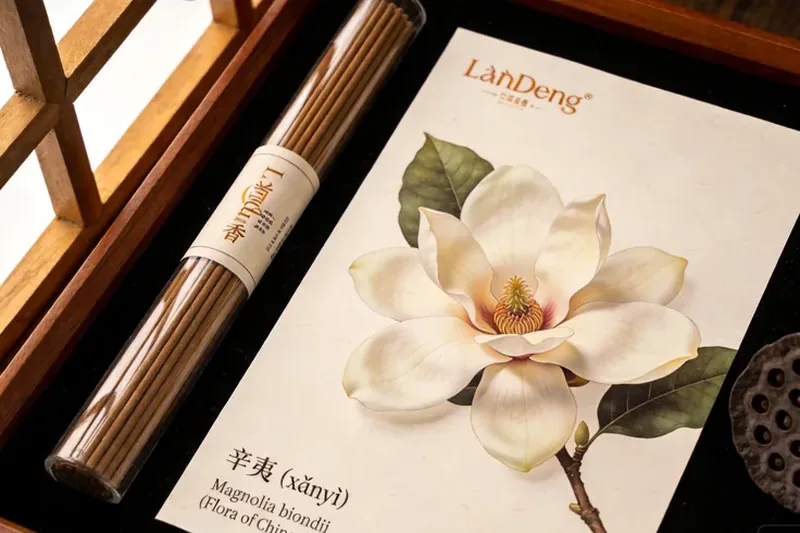
Direct answer: Magnolia flower bud (辛夷, xīnyí) is the dried flower bud of the magnolia tree, most classically Magnolia biondii (treated in Flora of China under Yulania biondii), a small tree native to central China. It is a floral-spicy aromatic with a green, slightly camphoraceous edge, used in Chinese incense as a floral top note. The name is also applied to closely related magnolias such as Magnolia denudata.
Key facts
| Chinese | 辛夷 (xīnyí) — the dried flower bud |
| Botanical source | Magnolia biondii (family Magnoliaceae); also M. denudata and related buds |
| What it is | A dried flower bud, not a wood or resin |
| Aroma | Floral, spicy, green, slightly camphoraceous |
| Traditional role | Floral top note; scenting material |
Aroma profile
Direct answer: 辛夷 is floral and spicy at once — a soft magnolia bloom crossed with a green, slightly camphoraceous sharpness from its essential oil. It is lighter and spicier than creamy, heady florals like jasmine or gardenia, sitting closer to a green-floral register. In a blend it works as a floral top note, adding lift and a fresh, slightly aromatic edge.
辛夷 is floral and spicy at once — a soft magnolia bloom crossed with a green, slightly camphoraceous sharpness from its essential oil. It is lighter and spicier than the creamy, heady florals like jasmine or gardenia, sitting closer to a “green floral” register. In a blend it works as a floral top note, adding lift and a fresh, slightly aromatic edge rather than deep sweetness.
Botanical identity
Direct answer: The classical source is Magnolia biondii, a deciduous tree of the magnolia family (Magnoliaceae) reaching about 12 m tall, native to the mountains of central China. Flora of China places it in the segregate genus Yulania (as Yulania biondii); GBIF accepts Magnolia biondii. Its flowers appear before the leaves and are fragrant.
The classical source is Magnolia biondii, a small deciduous tree of the magnolia family (Magnoliaceae) native to the mountains of central China (Shaanxi, Gansu, Henan, Sichuan). Flora of China describes a tree to about 12 m tall whose fragrant flowers appear before the leaves, with nine tepals — the outer three sepaloid and purplish-red, the inner ones white but often purplish-red at the base. Flora of China places it in the segregate genus Yulania as Yulania biondii; GBIF accepts Magnolia biondii. The part used is the dried, unopened flower bud, gathered in late winter or early spring before the flower opens. In practice, 辛夷 may refer to the buds of several closely related spring-flowering magnolias, including the white magnolia Magnolia denudata (玉兰). See Magnolia biondii on GBIF and Yulania biondii in Flora of China.
Chinese name and terminology
Direct answer: 辛夷 (xīnyí) names the dried magnolia flower bud — the “辛” pointing to its pungent, spicy aromatic quality. The name covers the buds of closely related spring magnolias, so it is a material name rather than a single-species label. It is distinct from 玉兰 (the open white magnolia flower) and 白兰花 (champaca).
辛夷 (xīnyí) is the classical name for the magnolia bud, with 辛 (“pungent/spicy”) recording its aromatic bite. The terminology matters because the name is a material name, not a rigid single-species label:
- 辛夷 — the dried bud, most classically Magnolia biondii (Yulania biondii), but also M. denudata and related spring magnolias. This entry.
- 玉兰 (yulan) — Magnolia denudata, the white magnolia; its open flower is the ornamental, while its bud can also supply 辛夷. See yulan-magnolia.
- 白兰花 (champaca) — Michelia alba, a headier, sweeter magnolia-family flower. See champaca.
辛夷 vs 玉兰: same family, different parts (read this)
Direct answer: 辛夷 and 玉兰 belong to the same magnolia family, and their buds can even overlap in source, but they name different things in practice: 辛夷 is the dried unopened bud used as an aromatic, while 玉兰 is the open ornamental flower. The two are related materials, not one plant with two unrelated names.
This is the key same-family distinction. 辛夷 (magnolia bud, Magnolia biondii and related) and 玉兰 (yulan, Magnolia denudata) sit in the same magnolia family, and because the bud of M. denudata can also supply 辛夷, the two entries overlap at the source:
- 辛夷 — the dried unopened bud, the aromatic material.
- 玉兰 — the open flower of Magnolia denudata, the ornamental celebrated in gardens.
The practical point: 辛夷 is a bud material defined by its part and its spicy-floral character, while 玉兰 is a flower defined by its bloom. They are related, and a single tree can supply both names, but a buyer should know whether they are asking for the dried bud (辛夷) or the open flower (玉兰). 辛夷 is also distinct from 白兰花 (champaca, Michelia alba) and from 梅花 (plum blossom, Prunus mume), which is in an entirely different family.
Where does magnolia flower come from?
Direct answer: Magnolia biondii is native to the mountains of central China — Shaanxi, Gansu, Henan, and Sichuan — where its buds are gathered in late winter or early spring before the flowers open. The closely related white magnolia Magnolia denudata shares this central-Chinese range.
The classical source Magnolia biondii grows in the mountains of central China (Shaanxi, Gansu, Henan, Sichuan), and the buds are harvested in late winter or early spring, before the flowers open. The closely related Magnolia denudata (玉兰) shares this central-Chinese distribution, which is why 辛夷 in practice may be sourced from more than one spring magnolia. This is a seasonal harvest tied to the bud stage — the material is gathered in a narrow window when the bud is full but unopened.
Why is it used in incense?
Direct answer: 辛夷 is used in incense as a light, spicy floral top note and as a scenting material for garments and spaces. Its green, slightly camphoraceous edge adds lift and freshness to a blend without the heady sweetness of jasmine or gardenia, so it reads as a green-floral accent rather than a deep or sweet base.
辛夷’s role in incense is as a light, spicy-floral top note. Its green, slightly camphoraceous edge lifts a blend with freshness, and it is also used as a scenting material for garments and spaces. It is lighter and spicier than the creamy heady florals, so it functions as an accent — adding a fresh, aromatic lift — rather than a sweet, heavy centerpiece. It is typically blended rather than burned alone.
How is it processed?
Direct answer: 辛夷 is the dried, unopened flower bud, gathered in late winter or early spring and dried whole. It is used as whole dried buds for scenting, or ground to powder for blending into sticks and cones. The key processing point is timing — the bud must be picked before it opens.
The part used is the unopened flower bud, harvested before the flower opens and dried. Processing is simple:
- Whole dried buds — used for scenting garments and spaces, and for slow aromatic release.
- Powder — ground bud for blending into sticks and cones; particle size and moisture affect how the powder packs and burns.
The critical processing point is harvest timing: the bud is gathered while still closed, when its essential oil is at its freshest — an opened flower is a different, lower-intensity material. The grinding mechanics sit within the wider how incense is made process.
What determines magnolia flower quality?
Direct answer: Quality turns on bud condition and aroma: good 辛夷 is clean, intact, unopened buds with a fresh spicy-floral scent. Broken, opened, or faded buds are lower grade. Source species — Magnolia biondii or a related magnolia such as M. denudata — is a labeling point, not a defect.
The practical quality points, in rough order:
- Bud integrity and stage — clean, intact, unopened buds are the standard; opened or broken buds are lower grade.
- Aroma — a fresh, spicy-floral, slightly camphoraceous scent; faded buds lose this.
- Cleanliness — freedom from twigs, leaf, and foreign material.
- Source species — Magnolia biondii or a related magnolia such as M. denudata; a labeling point, not a quality defect.
辛夷 carries no standardized commercial grading ladder — it is a seasonal bud material — so quality means bud integrity, freshness, and correct harvesting stage.
Common forms
Direct answer: 辛夷 is sold as whole dried buds and as ground powder. Whole buds suit scenting and slow release; powder suits stick-making. The forms are the same bud in different physical states, and the bud — not the open flower — is the standard material.
| Form | Typical use |
|---|---|
| Whole dried buds | Scenting garments and spaces; slow release |
| Powder | Incense sticks and cones |
In Chinese tradition
- Incense and scenting: 辛夷 is used as a light, spicy floral note in incense and as a scenting material for garments and spaces.
- Flowering culture: the magnolia is a celebrated ornamental of classical Chinese gardens, and its buds carry the flower’s early-spring association.
- Materia medica: 辛夷 is recorded in traditional Chinese medicine (本草綱目, 木部), where it is traditionally associated with the nose and nasal passages. This is traditional materia-medica language, not modern clinical evidence.
Traditional use vs modern evidence
Direct answer: 辛夷’s aromatic use is documented in classical records. Its medicinal uses — including the traditional nasal association — are traditional, not established clinical fact, and this page makes no medical claims. The documented non-medical facts are its botanical identity, the Magnolia/Yulania placement, and its floral-spicy aromatic use.
- Traditional Use — 辛夷 is a light, spicy floral incense note and a scenting material for garments and spaces.
- Historical Record — 辛夷 is recorded in the 本草綱目 (木部) with a traditional nasal association; the bud is the classical aromatic material.
- Scientific Evidence — the bud’s essential oil is characterized, but we present no clinical or medical efficacy claims.
The aromatic use is documented in classical records. Medicinal uses — including the traditional nasal association — are traditional, not established clinical fact, and we make no medical claims.
What buyers should look for
Direct answer: Buyers should check for clean, intact, unopened buds with a fresh spicy-floral scent, and confirm the source species (Magnolia biondii or a related magnolia). For powder, confirm particle size and moisture against the formula. And keep the same-family distinction in mind: 辛夷 is the bud, not the open 玉兰 flower.
For an incense maker or sourcing buyer:
- Bud integrity and stage — intact, unopened buds are the standard; opened or broken buds are lower grade.
- Aroma — a fresh spicy-floral, slightly camphoraceous scent.
- Source species — Magnolia biondii or a related magnolia such as M. denudata; ask, as the label may not say.
- Powder consistency — confirm particle size and moisture, and test a sample against your formula.
Our Industry View
Direct answer: 辛夷’s commercial interest is as a fresh, spicy floral top note, but its real lesson is the part-versus-flower distinction: the value is in the unopened bud, and an opened flower is a different, lower-intensity material. The same-family overlap with 玉兰 makes the species and part worth specifying rather than trusting the name alone.
From a manufacturing perspective, 辛夷 is a seasonal, part-specific material, and that specificity is the whole commercial point. Two observations follow:
- The part is the specification. 辛夷 is the unopened bud, harvested in a narrow late-winter window when its essential oil is freshest. An opened flower — or a harvest taken too late — is a lower-intensity material even if it comes from the same tree. A buyer’s first check is therefore bud integrity and stage, not just the name.
- The same-family overlap is a labeling question, not a defect. Because the buds of Magnolia biondii and Magnolia denudata (玉兰) can both supply 辛夷, the name alone does not pin down the species. This is normal in the trade, but a buyer who wants reproducibility should specify species and part — bud, not flower — rather than accept an unqualified “辛夷.”
In our view, 辛夷 is a light, spicy floral top note worth having for its fresh lift — buy it as clean unopened buds, confirm the source species, and treat the part-versus-flower distinction as the core quality question.
Summary
辛夷 (magnolia flower bud) is the dried unopened bud of Magnolia biondii (Flora of China: Yulania biondii) and related central-Chinese magnolias such as M. denudata (玉兰). It is a floral-spicy aromatic with a green, camphoraceous edge, used as a light top note and scenting material. Its value rests on bud integrity and harvest stage rather than rarity, it sits in the same family as 玉兰 and 白兰花 (champaca) but is distinct from them, and its medicinal uses are traditional language, not clinical evidence.
FAQ
What is 辛夷 (xinyi)? The dried, unopened flower bud of the magnolia tree, most classically Magnolia biondii (Flora of China: Yulania biondii), a small tree of the magnolia family native to central China. It is a floral-spicy aromatic with a green, slightly camphoraceous edge, used in Chinese incense as a floral top note. The name is also applied to the buds of related magnolias such as the white magnolia Magnolia denudata (玉兰).
What does 辛夷 smell like? Floral and spicy at once — a soft magnolia bloom crossed with a green, slightly camphoraceous sharpness from its essential oil. It is lighter and spicier than creamy, heady florals like jasmine or gardenia, sitting closer to a “green floral” register. In a blend it adds lift and a fresh, slightly aromatic edge rather than deep sweetness.
How does 辛夷 differ from 玉兰 (yulan)? They are the same magnolia family and can overlap in source, but they name different things in practice. 辛夷 is the dried unopened bud used as an aromatic; 玉兰 is the open flower of Magnolia denudata, the ornamental. A single tree can supply both names, but a buyer should know whether they are asking for the bud (辛夷) or the flower (玉兰).
How does 辛夷 differ from 白兰花 (champaca)? They are both magnolia-family flowers but distinct materials. 辛夷 is the flower bud of Magnolia biondii and related spring magnolias, with a green, spicy-floral character. 白兰花 (white champaca) is Michelia alba, a headier, sweeter, more fruity white floral. And 梅花 (plum blossom, Prunus mume) is in an entirely different family. Each has its own entry in this encyclopedia.
What part of the plant is used? The dried, unopened flower bud, gathered in late winter or early spring before the flower opens. The bud, not the open flower, is the traditional material — it concentrates the plant’s spicy-floral essential oil at its freshest. In practice 辛夷 may come from Magnolia biondii or a closely related magnolia such as M. denudata.
Is 辛夷 only used in incense? No — it is also recorded in traditional Chinese medicine, where it is classically associated with the nose and nasal passages (本草綱目, 木部). That medicinal association is traditional language, not modern clinical evidence, and this encyclopedia makes no medical claims. Its documented non-medical uses are the aromatic and scenting roles described here.
See also: champaca, plum-blossom, gardenia, yulan-magnolia, and the full scent guide.
Evidence & Sources
Botanical identity
Source: Magnolia biondii on GBIF · Yulania biondii in Flora of China. Evidence type: Established.
Traditional Chinese use
Source: 辛夷 as a floral top note and scenting material, and its traditional nasal association, recorded in the 本草綱目 木部. Evidence type: Historically documented — aromatic use; medicinal uses are traditional, not modern clinical evidence.
Authenticity / disambiguation
Source: 辛夷 (Magnolia biondii / Yulania biondii) vs 白兰花 (Michelia alba) vs 梅花 (Prunus mume); and the 辛夷 (bud) vs 玉兰 (open flower) same-family distinction. Evidence type: Practical screening.
Safety
Source: incense combustion produces smoke and particulate matter; burn in a well-ventilated space. Evidence type: Established.
Evidence status
| Layer | Status |
|---|---|
| Botanical identity | Established |
| Traditional use | Historically documented |
| Authenticity test | Practical screening |
| Health claims | Not established |
Sources
Sources: botanical references on Magnolia biondii (Yulania biondii) and the magnolia-vs-champaca-vs-plum distinction. 辛夷 is recorded as a floral-spicy aromatic; medicinal uses are treated as traditional, not established clinical fact. This is editorial knowledge content, not medical advice.