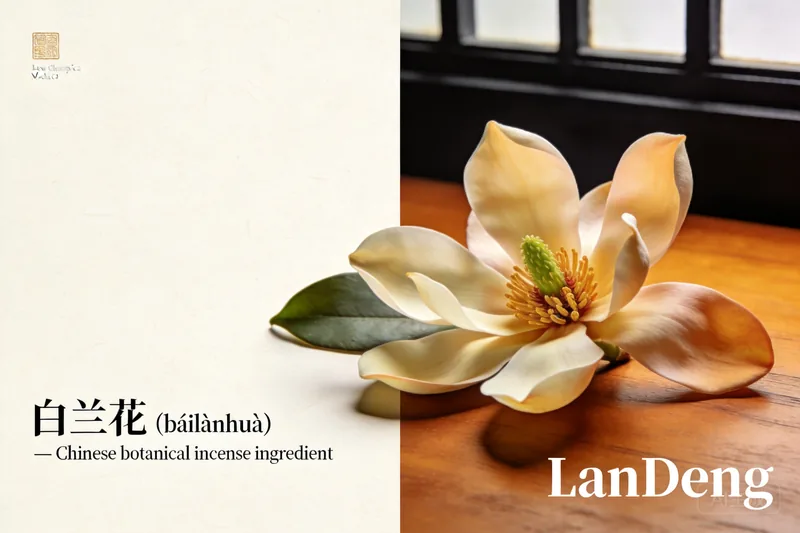
Technical answer: Champaca — báilánhuā (白兰花) in Chinese — is the intensely fragrant white flower of Michelia alba (now often placed as Magnolia × alba), a magnolia-family tree cultivated across southern China and Southeast Asia. It is a heady, sweet, slightly fruity white-floral, widely used to scent tea, sachets, and floral incense. The flower is also one of the defining scents of southern-Chinese fragrance culture, worn as a fresh blossom in daily life.
Key facts
| Chinese | 白兰花 (báilánhuā), “white orchid flower”; also 白玉兰/白兰 |
| Botanical source | Michelia alba (syn. Magnolia × alba, family Magnoliaceae) — the flower |
| What it is | A fragrant white flower, not a wood or resin |
| Aroma | Sweet, heady, white-floral, slightly fruity |
| Traditional role | Tea scenting, sachets, floral incense, worn blossom |
Aroma profile
Champaca is sweet, heady, and white-floral, with a slightly fruity, almost tropical lift that distinguishes it from the creamier gardenia or the sharper jasmine. It is a rich, enveloping floral note, strongest in the fresh blossom. The fresh flower is worn and used to scent tea; in incense the dried or oil form is used as a delicate floral accent.
Botanical source and origin
Michelia alba is a magnolia-family tree native to Southeast Asia and long cultivated in southern China, where it is grown for its fragrant white blossoms. Taxonomically it has moved between Michelia and Magnolia; the currently accepted name is Magnolia × alba, with Michelia alba widely used as a synonym. The flower is the part used.
A naming caution: 白兰花 (Michelia alba, white champaca) is not an orchid despite the 兰 in its name. It belongs to the magnolia family. It is also distinct from the pale-flowered 玉兰 (yulan, Magnolia denudata), a different magnolia.
In Chinese tradition
- Tea scenting: 白兰花 is used to scent tea, one of the classical aromatic techniques of southern China, alongside jasmine and osmanthus.
- Worn blossom: the fresh flower is famously worn in daily life in southern China for its scent — a living, personal fragrance rather than a burned material.
- Floral incense and sachets: the flower’s heady scent is referenced in floral incense and sachet blends.
- Materia medica: 白兰花 has traditional aromatic uses. This is traditional materia-medica language, not modern clinical evidence.
Traditional use vs modern evidence
The fragrance and tea-scenting roles are well documented. Any medicinal use is traditional, not established clinical fact, and we make no medical claims. The documented, non-medical facts are botanical identity and the flower’s long use as a fresh, heady white-floral.
Quality and sourcing notes
Practical points for buyers:
- Champaca’s fragrance is strongest fresh; the dried flower is subtle, used as a delicate floral accent.
- Distinguish 白兰花 (Michelia alba, white champaca) from 玉兰 (Magnolia denudata, yulan) — different magnolias.
- In incense, champaca is usually a floral accent or a themed note, not a dominant burned material.
Safety
Incense combustion produces smoke and particulate matter. Burn in a well-ventilated space, avoid inhaling concentrated smoke, and keep away from children and pets. This is editorial knowledge content, not medical advice.
FAQ
What is champaca? The intensely fragrant white flower of Michelia alba (now Magnolia × alba), a magnolia-family tree cultivated across southern China and Southeast Asia. It is a heady, sweet, slightly fruity white-floral, used to scent tea and sachets, referenced in floral incense, and worn as a fresh blossom in daily life in southern China.
Is 白兰花 an orchid? No. Despite the 兰 in its name, 白兰花 (Michelia alba) is a magnolia-family tree, not an orchid. Chinese uses 兰 to name many fragrant plants, and 白兰花 belongs to the magnolia tradition. It is also distinct from the yulan magnolia (玉兰, Magnolia denudata), another white magnolia with a different identity.
What does champaca smell like? Sweet, heady, and white-floral, with a slightly fruity, almost tropical lift. It is a rich, enveloping floral note that sits between the creamier gardenia and the sharper jasmine. The scent is strongest in the fresh blossom, which is why the flower is worn fresh and used to scent tea rather than dried and burned heavily.
How is champaca used in Chinese culture? Three main ways: the fresh flower is worn for its scent in daily life, especially in southern China; the flowers scent tea in the classical aromatic technique; and the heady floral note is referenced in floral incense and sachets. It is primarily a living, personal fragrance and a tea-scenting flower, not a heavy burned material.
What is the botanical name for champaca? Michelia alba, now often treated as Magnolia × alba in the magnolia family (Magnoliaceae). Taxonomy has moved the species between the genera Michelia and Magnolia, so both names appear. The flower is the part used for its fragrance.
See also: jasmine, gardenia, and the full scent guide.
Evidence & Sources
Botanical identity
Source: Magnolia × alba (syn. Michelia alba) on GBIF · Michelia alba on GBIF. Evidence type: Established.
Traditional Chinese use
Source: 白兰花 as a tea-scenting flower, worn blossom, and floral-incense reference. Evidence type: Historically documented — aromatic and cultural use, not medical.
Authenticity / disambiguation
Source: 白兰花 (Michelia alba) vs 玉兰 (Magnolia denudata) — distinct magnolias; the 兰-in-name vs orchid distinction. Evidence type: Practical screening.
Safety
Source: incense combustion produces smoke and particulate matter; burn in a well-ventilated space. Evidence type: Established.
Evidence status
| Layer | Status |
|---|---|
| Botanical identity | Established |
| Traditional use | Historically documented |
| Authenticity test | Practical screening |
| Health claims | Not established |
Sources
Sources: botanical references on Michelia alba (syn. Magnolia × alba) and the 白兰花/玉兰 distinction. Champaca’s fragrance and tea-scenting roles are documented; any medicinal use is treated as traditional, not established clinical fact. This is editorial knowledge content, not medical advice.