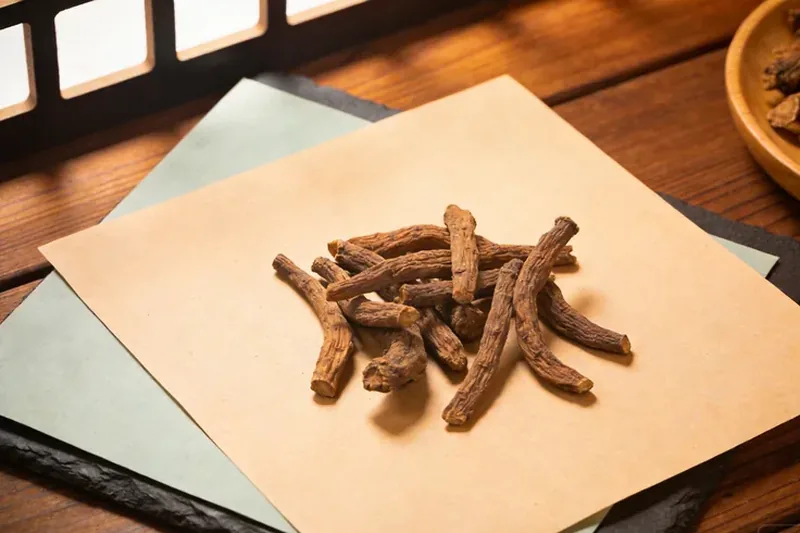
Direct answer: Asarum (细辛, xìxīn) is the dried root and rhizome of Asarum sieboldii, a low woodland herb of the birthwort family (Aristolochiaceae) native to China, Korea, and Japan. Its name means “thin and pungent,” from the slender root’s intense, spicy, camphoraceous scent. It is a classical Chinese materia-medica root, not a documented sachet or incense ingredient.
Key facts
| Chinese | 细辛 (xìxīn); classical aliases 小辛 (xiǎoxīn), 少辛 (shàoxīn) |
| Botanical source | Asarum sieboldii (family Aristolochiaceae) — the root and rhizome |
| What it is | A woodland-herb root, pungent and aromatic |
| Aroma | Pungent, spicy, rooty, camphoraceous |
| Traditional role | Materia medica; no documented 香囊 or incense role |
Aroma profile
细辛 has an intense, pungent, spicy, rooty scent with a camphoraceous, almost pepper-like bite — the hot, aromatic smell of a wild-ginger root rather than a flower or leaf. It is a sharp, medicinal aromatic, far hotter and more biting than the sweet, resinous 香材. Its name records exactly this: 细 (“slender”) + 辛 (“pungent”), the thin root with the very hot taste and smell.
The 细辛 / 杜衡 distinction (read this)
细辛 has a classical look-alike worth knowing:
- 细辛 (asarum) — Asarum sieboldii, the slender, intensely pungent root. This entry.
- 杜衡 (wild ginger) — Asarum forbesii (and related Asarum species), a similar-looking root often passed off for 细辛.
The Bencao Gangmu (本草纲目), 草之二, quotes Shen Kuo’s Mengxi Bitan: 细辛 grows on Mount Hua, “極細而直,柔韌,深紫色,味極辛” (extremely thin, straight, pliant, deep purple, very pungent), and warns that 杜衡 (with curved, brittle, yellow-white roots) was long sold in its place — “杜衡亂細辛,自古已然矣.” This page describes 细辛 = Asarum sieboldii.
Botanical source and origin
Asarum sieboldii is a low, shade-loving woodland herb in the birthwort family (Aristolochiaceae), native to China, Korea, and Japan. Flora of China records the species (细辛), alongside the closely related Asarum heterotropoides, which is also gathered as 细辛 in northern China. The part used is the slender, aromatic root and rhizome, dug and dried.
In Chinese tradition
- Materia medica: 细辛 is a classical materia-medica root, recorded in the Bencao Gangmu (本草纲目), 草之二. This is traditional materia-medica language, not modern clinical evidence.
- Naming: the Bencao Gangmu records the aliases 小辛 and 少辛 and explains “華州真細辛,根細而味極辛” — the true 细辛 has a thin root and an extremely pungent taste.
- A documented caution: classical texts note 细辛 is potent and was used in small amounts — a materia-medica dosing caution, not an incense note.
Traditional use vs modern evidence
The materia-medica record is traditional, not established clinical fact, and we make no medical claims. The documented facts are botanical identity, the Aristolochiaceae placement, and the 杜衡 look-alike distinction.
A note on 香囊 (sachet) use
We did not find 细辛 documented as a classical 香囊 or incense ingredient in the incense manuals and materia-medica records consulted here. Its classical role is materia medica, and its pungent root scent is medicinal rather than a fragrance for sachets or burning. This is stated honestly: no sachet or incense origin is claimed.
Quality and sourcing notes
Practical points for buyers:
- 细辛 is the slender root of Asarum sieboldii; expect an intense, pungent, spicy, camphoraceous scent.
- Distinguish it from 杜衡 (Asarum forbesii), a similar wild-ginger root with curved, brittle, yellow-white roots — a classical substitution warning.
- It is a sharp aromatic root, not a sweet incense 香材; its classical role is materia medica.
Safety
Incense combustion produces smoke and particulate matter. Burn in a well-ventilated space, avoid inhaling concentrated smoke, and keep away from children and pets. 细辛’s classical record carries dosing cautions; this page is about fragrance identification, not use. This is editorial knowledge content, not medical advice.
FAQ
What is 细辛 (asarum)? The dried root and rhizome of Asarum sieboldii, a low woodland herb of the birthwort family (Aristolochiaceae) native to China, Korea, and Japan. Its name means “thin [and] pungent,” from the slender root’s intense, spicy, camphoraceous scent. It is a classical Chinese materia-medica root.
What does 细辛 mean? 细 means “slender” and 辛 means “pungent.” The Bencao Gangmu (本草纲目), 草之二, explains “華州真細辛,根細而味極辛” — the true 细辛 has a thin root and an extremely pungent taste. The classical aliases 小辛 and 少辛 carry the same meaning.
Is 细辛 the same as 杜衡? No. 细辛 is Asarum sieboldii, slender and very pungent; 杜衡 is Asarum forbesii, a similar wild-ginger root with curved, brittle, yellow-white roots. The Bencao Gangmu warns that 杜衡 was long sold in 细辛’s place — “杜衡亂細辛,自古已然矣.”
Is 细辛 an incense or sachet (香囊) ingredient? We did not find it documented as a classical 香囊 or incense ingredient. Its classical role is materia medica (草之二), and its pungent root scent is medicinal rather than a fragrance for sachets or burning. No sachet or incense origin is claimed.
What does asarum smell like? Intense, pungent, spicy, and rooty, with a camphoraceous, almost pepper-like bite — the hot, aromatic smell of a wild-ginger root. It is far sharper and more medicinal than the sweet, resinous incense 香材.
See also: ligusticum (藁本), angelica (白芷), atractylodes (苍术), and the full scent guide.
Evidence & Sources
Botanical identity
Source: Asarum sieboldii in Flora of China · Asarum sieboldii on GBIF. Evidence type: Established.
Traditional Chinese use
Source: the Bencao Gangmu (本草纲目), 草之二, records 细辛 (“華州真細辛,根細而味極辛”), with the 杜衡 look-alike warning. Evidence type: Historically documented — materia medica; medicinal uses are traditional, not modern clinical evidence.
Sachet / incense use
Source: no documented 香囊 or incense role found in the incense manuals and materia-medica records consulted. Evidence type: Absence of documented classical use (defined scope) — none claimed.
Safety
Source: incense combustion produces smoke and particulate matter; burn in a well-ventilated space. Evidence type: Established.
Evidence status
| Layer | Status |
|---|---|
| Botanical identity | Established |
| Traditional use | Historically documented (materia medica) |
| Sachet / incense use | Not documented |
| Health claims | Not established |
Sources
Sources: botanical references on Asarum sieboldii and the Bencao Gangmu (本草纲目) 草之二 record of 细辛. 细辛 is a materia-medica root; no sachet or incense origin is claimed. Medicinal uses are treated as traditional, not established clinical fact. This is editorial knowledge content, not medical advice.