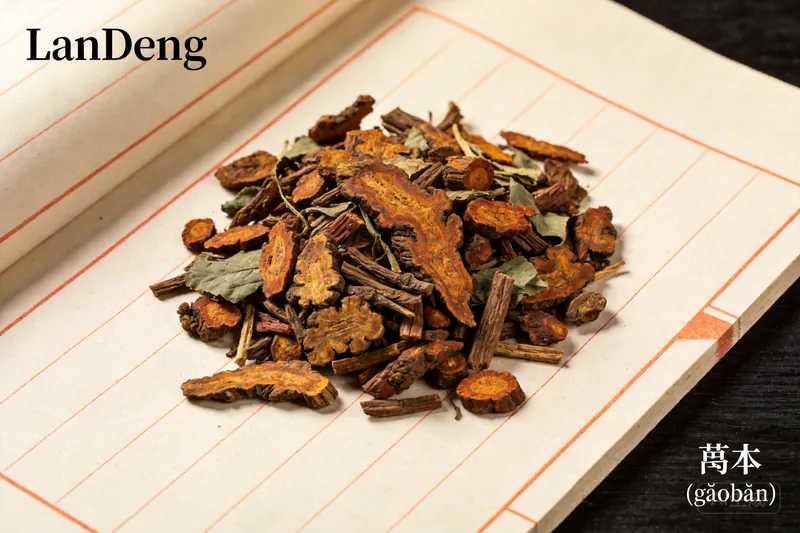
Technical answer: Ligusticum — gǎoběn (藁本) in Chinese — is the dried root and rhizome of Ligusticum sinense, an aromatic herb of the carrot family (Apiaceae) native to China. It is a classical Chinese incense ingredient with a herbal, slightly spicy, aromatic root character, best known in the incense record as one of the named ingredients of the 寿阳公主梅花香 (Shouyang princess’s plum incense) formula, where it supplies a herbal middle tone alongside spikenard and angelica.
Key facts
| Chinese | 藁本 (gǎoběn) |
| Botanical source | Ligusticum sinense (family Apiaceae) — the dried root/rhizome |
| What it is | A dried aromatic root, not a wood or resin |
| Aroma | Herbal, aromatic, slightly spicy and woody |
| Traditional role | 合香 herbal middle note; materia medica |
Aroma profile
Ligusticum root is herbal and aromatic, with a slightly spicy, warming, faintly woody character typical of the carrot-family aromatic roots. It is a middle note — it sits in the herbal register of a blend, supporting and grounding brighter or sweeter ingredients. In classical formulas it is roasted or dried and ground, and it contributes body rather than a leading scent.
Botanical source and origin
Ligusticum sinense is an herbaceous plant of the Apiaceae family, native to China. The part used is the root and rhizome, harvested, cleaned, and dried. The genus Ligusticum groups aromatic “lovage-like” herbs of the carrot family, several of which are used as spices and incense materials.
A naming caution: The English word “lovage” is sometimes applied to 藁本, but true lovage is Levisticum officinale, a different plant. 藁本 is Ligusticum sinense — a related but distinct aromatic root. Labels using “lovage” for a Chinese incense ingredient may conflate the two.
In Chinese tradition
- 合香 (blended incense): 藁本 is a named ingredient in classical 合香 formulas, most famously the 寿阳公主梅花香 (Shouyang princess’s plum incense), recorded in the Ming-dynasty Xiang Cheng (香乘) with 藁本 at 半两. It supplies a herbal middle tone in the blend.
- Herbal middle note: in the plum-incense accord, 藁本 sits with spikenard and angelica as the herbal, slightly medicinal middle register beneath the plum and wood notes.
- Materia medica: 藁本 is recorded in traditional Chinese medicine. This is traditional materia-medica language, not modern clinical evidence.
Traditional use vs modern evidence
The incense use is documented in the classical recipe record. Medicinal uses are traditional, not established clinical fact, and we make no medical claims. The documented, non-medical facts are botanical identity and 藁本’s role as a herbal aromatic in classical blended incense.
Quality and sourcing notes
Practical points for buyers:
- Ligusticum root should be clean and dry, with a herbal, aromatic, slightly spicy scent when warmed.
- Note that “lovage” on an English label may mean either true lovage (Levisticum officinale) or 藁本 (Ligusticum sinense) — confirm the species for incense use.
- 藁本 is a supporting herbal note, usually blended, not burned alone.
Safety
Incense combustion produces smoke and particulate matter. Burn in a well-ventilated space, avoid inhaling concentrated smoke, and keep away from children and pets. This is editorial knowledge content, not medical advice.
FAQ
What is 藁本 (gǎoběn)? The dried root and rhizome of Ligusticum sinense, an aromatic herb of the carrot family native to China. It is a classical Chinese incense ingredient with a herbal, slightly spicy, faintly woody root character. In the incense record it is best known as a named ingredient of the 寿阳公主梅花香 (Shouyang princess’s plum incense) formula, recorded in the Xiang Cheng (香乘).
Is 藁本 the same as lovage? Not exactly. The English “lovage” usually names Levisticum officinale, while 藁本 is Ligusticum sinense — a related but distinct carrot-family aromatic root. The two are sometimes conflated on English labels for Chinese incense ingredients, so the species should be confirmed when “lovage” is used for a 藁本 material.
What does ligusticum smell like? Herbal and aromatic, with a slightly spicy, warming, faintly woody character typical of carrot-family roots. It is a middle note that sits in the herbal register of a blend, supporting and grounding brighter or sweeter ingredients, rather than leading with a bright or floral scent.
Where does 藁本 appear in classical incense? Most famously in the 寿阳公主梅花香 (Shouyang princess’s plum incense), recorded in the Ming-dynasty Xiang Cheng (香乘), where 藁本 is listed at 半两. There it supplies a herbal middle tone alongside spikenard (甘松) and angelica (白芷), beneath the plum and wood notes that give the accord its name. See our page on the Shouyang princess plum recipe.
What part of the plant is used? The root and rhizome, harvested, cleaned, and dried. The aromatic character comes from the root rather than the leaves or seeds, and the dried root is ground for use in blended incense. It is a supporting herbal note, usually blended rather than burned alone.
See also: spikenard-nardostachys, angelica, the Shouyang princess plum recipe, and the full scent guide.
Evidence & Sources
Botanical identity
Source: Ligusticum sinense in Flora of China · Ligusticum sinense on GBIF. Evidence type: Established.
Traditional Chinese use
Source: 藁本 listed at 半两 in the 寿阳公主梅花香 formula (香乘, 卷十八). Evidence type: Historically documented — incense use; medicinal uses are traditional, not modern clinical evidence.
Authenticity / disambiguation
Source: 藁本 (Ligusticum sinense) vs true lovage (Levisticum officinale) — related but distinct roots. Evidence type: Practical screening.
Safety
Source: incense combustion produces smoke and particulate matter; burn in a well-ventilated space. Evidence type: Established.
Evidence status
| Layer | Status |
|---|---|
| Botanical identity | Established |
| Traditional use | Historically documented |
| Authenticity test | Practical screening |
| Health claims | Not established |
Sources
Sources: botanical references on Ligusticum sinense and the 寿阳公主梅花香 (香乘) record of 藁本. Medicinal uses are treated as traditional, not established clinical fact. This is editorial knowledge content, not medical advice.