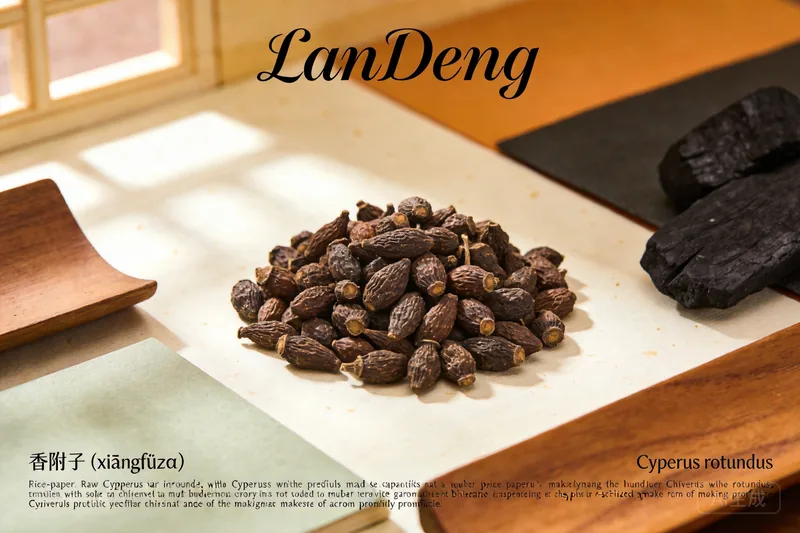
Technical answer: Cyperus — xiāngfùzǐ (香附子, “fragrant fuzi tuber”) in Chinese — is the aromatic tuber/rhizome of Cyperus rotundus, the purple nutsedge, one of the world’s most widespread weeds. It is a classical Chinese incense blending ingredient, and it serves as a traditional substitute where the rarer spikenard (甘松) is unavailable.
Key facts
| Chinese | 香附子 (xiāngfùzǐ), also 香附 / 莎草根 / 雀头香 |
| Botanical source | Cyperus rotundus (family Cyperaceae) — the tuber/rhizome |
| What it is | An aromatic tuber, not a wood or resin |
| Aroma | Woody, spicy, earthy, slightly smoky |
| Traditional role | 合香 (blended incense), materia medica |
Aroma profile
香附子 has a woody, spicy, earthy aroma with a slightly smoky, rooty undertone — a grounded, dry note rather than a sweet or floral one. It is a supporting incense material, contributing earthy body and warmth to a blend. Its character is close enough to spikenard’s earthy-sweet root note that it has served as a traditional stand-in.
A humble plant with a big role
Cyperus rotundus (purple nutsedge) is an ordinary-looking sedge — and one of the most widespread weeds on earth — but its small, aromatic tubers made it a standard incense and materia-medica item. The name 香附子 (“fragrant fuzi tuber”) reflects both its scent and the tuber’s resemblance to the fuzi (aconite) root. Classical sources record several names for it, including 莎草根 (sedge root) and 雀头香 (“sparrow-head incense,” from the tuber’s shape).
In Chinese tradition
- 合香 (blended incense): 香附子 is a classical blending ingredient. It appears in standard formulas — the Xiangcheng (香乘) records it in the Han-dynasty 建宁宫中香 palace-incense formula alongside 藿香, 零陵香, 檀香, 白芷, 甘松, and others.
- A traditional substitute for spikenard: 香附子 has been used where 甘松 (spikenard) is scarce or costly — a substitution recorded in classical and trade practice.
- Materia medica: 香附 is a major traditional-medicine herb, classically described for “regulating qi” (理气) and related uses. This is traditional materia-medica language, not modern clinical evidence.
Traditional use vs modern evidence
The aromatic role — a blending tuber and a spikenard substitute — is well documented in the classical manuals. The medicinal uses are traditional, not established clinical fact, and we make no medical claims. The documented, non-medical facts are botanical identity and cyperus’s long use as a common, earthy incense tuber.
Quality and sourcing notes
Practical points for buyers:
- 香附子 is the tuber of Cyperus rotundus (purple nutsedge) — a common, abundant plant, in contrast to the scarce wild spikenard it sometimes substitutes for.
- It should smell woody-spicy and earthy; the tuber is small and dense.
- In incense it is a blender, used for earthy body rather than as a solo fragrance.
Safety
Incense combustion produces smoke and particulate matter. Burn in a well-ventilated space, avoid inhaling concentrated smoke, and keep away from children and pets. This is editorial knowledge content, not medical advice.
FAQ
What is 香附子? 香附子 is the aromatic tuber of Cyperus rotundus, the purple nutsedge — an ordinary-looking sedge that is one of the world’s most widespread weeds. Its small tubers carry a woody, spicy, earthy scent and made it a standard Chinese incense blending ingredient, as well as a traditional-medicine herb. The name means “fragrant fuzi tuber,” referring to its scent and the tuber’s resemblance to aconite root.
Is 香附子 the same as spikenard? No, but it has served as a traditional substitute. 香附子 is Cyperus rotundus (a sedge); spikenard (甘松) is Nardostachys jatamansi (a Himalayan herb). Their earthy root notes are similar enough that cyperus has been used where the scarcer spikenard is unavailable or costly — a substitution recorded in classical and trade practice, not a botanical identity.
What does cyperus smell like? Cyperus tuber has a woody, spicy, earthy aroma with a slightly smoky, rooty undertone — a grounded, dry note rather than a sweet or floral one. It is a supporting incense material, contributing earthy body and warmth to a blend, and its character is close enough to spikenard’s earthy-sweet note that it has worked as a stand-in.
What are the other names for 香附子? Classical sources record several names, including 香附 (the shortened form), 莎草根 (“sedge root,” from the plant Cyperus rotundus), and 雀头香 (“sparrow-head incense,” from the tuber’s shape). The variety of names reflects the plant’s ubiquity and its long use across regions, rather than any confusion about the plant itself.
How is cyperus used in incense? Cyperus is a classical 合香 (blended-incense) ingredient. The Ming-dynasty Xiangcheng (香乘) records it in the Han-dynasty 建宁宫中香 palace-incense formula alongside 藿香, 零陵香, 檀香, 白芷, and 甘松. It contributes an earthy, woody body and warmth — a supporting note that grounds a formula rather than leading with a bright fragrance.
See also: vetiver, calamus, and the full scent guide.
Evidence & Sources
Botanical identity
Source: Cyperus rotundus in Flora of China · Cyperus rotundus on GBIF. Evidence type: Established.
Traditional Chinese use
Source: the Song-dynasty Xiangpu (香譜) records 香附子 as 雀头香 / 莎草根 (卷二, citing 《本草》); the Ming Xiangcheng (香乘) records it in the Han-dynasty 建宁宫中香 palace-incense formula. Evidence type: Historically documented — traditional, not modern clinical evidence.
Authenticity / disambiguation
Source: the 香附子 (Cyperus rotundus) vs 甘松 (Nardostachys jatamansi) substitution note. Evidence type: Practical screening.
Safety
Source: incense combustion produces smoke and particulate matter; burn in a well-ventilated space. Evidence type: Established.
Evidence status
| Layer | Status |
|---|---|
| Botanical identity | Established |
| Traditional use | Historically documented |
| Authenticity test | Practical screening |
| Health claims | Not established |
Sources
Sources: botanical references on Cyperus rotundus and the Song-dynasty Xiangpu (香譜) / Ming Xiangcheng (香乘) records of 香附子 (雀头香 / 莎草根). The 香附子 / 甘松 substitution note is recorded as classical and trade practice. Medicinal uses are treated as traditional, not established clinical fact. This is editorial knowledge content, not medical advice.