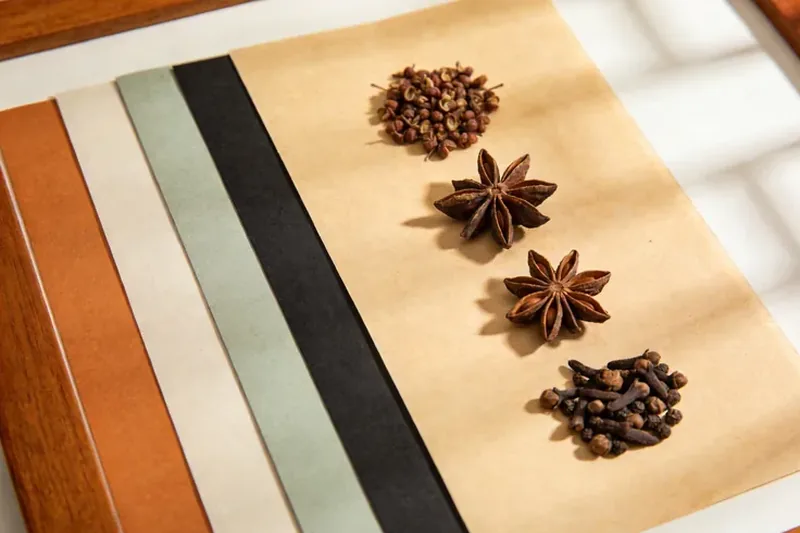
Direct answer: Pepper (胡椒, hújiāo) is the dried fruit of Piper nigrum, a climbing vine of the pepper family (Piperaceae) native to South India and long cultivated across the tropics. It is the world’s most common spice, with a hot, pungent, warm-woody scent from the alkaloid piperine. In Chinese incense it is a warming spice accent, used sparingly to add a sharp, penetrating top note to 合香 blends.
Key facts
| Chinese | 胡椒 (hújiāo); black pepper = 黑胡椒, white pepper = 白胡椒 |
| Botanical source | Piper nigrum (family Piperaceae) — the dried fruit |
| What it is | A dried spice, not a wood or resin |
| Aroma | Spicy, pungent, warm, faintly woody |
| Traditional role | Warming spice accent in 合香 |
Aroma profile
Direct answer: Black pepper is hot and penetrating, with a sharp, dry pungency over a warm, faintly woody base. The heat comes chiefly from piperine, an alkaloid, while the aromatic character comes from the volatile essential oil — which is why freshly ground pepper is far more fragrant than pre-ground. In a blend, pepper reads as a pungent spark that brightens and sharpens heavier woods and resins.
Black pepper is hot and penetrating, with a sharp, dry pungency over a warm, faintly woody base. The heat comes chiefly from piperine, an alkaloid, while the aromatic character comes from the volatile essential oil — which is why freshly ground pepper is far more fragrant than pre-ground. In a blend, pepper reads as a pungent spark: it brightens and sharpens heavier woods and resins, adding lift rather than body.
Botanical identity
Direct answer: Piper nigrum is a perennial climbing vine of the pepper family (Piperaceae), native to the Malabar coast of India and cultivated across the tropics for its fruit. The same fruit yields black, white, and green pepper depending on harvest time and processing. The genus Piper also includes long pepper (Piper longum) and cubeb (Piper cubeba).
Piper nigrum is a perennial climbing vine of the pepper family (Piperaceae), native to the Malabar coast of India and cultivated across the tropics for its fruit. The same fruit yields black, white, and green pepper depending on harvest time and processing: black pepper is the unripe fruit dried whole; white pepper is the ripe fruit with the outer husk removed; green pepper is the unripe fruit preserved fresh. The genus Piper also includes two other spice materials used in Chinese incense — 荜茇 (Piper longum) and 荜澄茄 (Piper cubeba) — which share a peppery family character but are distinct species. See Piper nigrum in Flora of China.
Chinese name and terminology
Direct answer: The name 胡椒 means “foreign pepper” — 胡 (foreign, from the west/northwest) + 椒 (the pepper/prickly-ash register). The 胡 prefix marks it as an introduced spice, distinguishing it from native 椒 plants such as 花椒 (Sichuan pepper). Black pepper is 黑胡椒, white pepper is 白胡椒.
The name 胡椒 (hújiāo) is a provenance marker: 胡 “foreign” (from the western regions) + 椒, the character for the pepper/prickly-ash class. The 胡 prefix records that pepper arrived in China as an introduced spice — distinguishing it from native 椒 plants such as 花椒 (Zanthoxylum, Sichuan pepper). The color forms are named plainly: 黑胡椒 (black pepper) and 白胡椒 (white pepper), the same fruit processed differently.
Heat is not fragrance (read this)
Direct answer: Pepper’s famous pungency and its fragrance are two different chemical facts. The heat comes from piperine, an alkaloid that is nearly odorless; the aroma comes from the volatile essential oil, which fades quickly once ground. For a formulator this split matters: you can have heat without fragrance (stale ground pepper) or a brief bright top note (freshly ground) — and the two behave differently in a blend.
Here is the chemical fact that changes how a formulator uses pepper:
- The heat is piperine. Pepper’s hot, biting pungency comes chiefly from piperine, an alkaloid. Piperine is what stings the tongue — and it is nearly odorless. Its heat persists even when the fragrance has gone.
- The fragrance is a separate volatile oil. The warm, woody, citrus-tinged aroma of pepper comes from its volatile essential oil, which is highly fugitive — it evaporates and oxidizes quickly once the fruit is ground. This is why freshly ground pepper smells dramatically stronger than pre-ground pepper: the oil is gone, but the piperine heat remains.
- The consequence for incense. A pepper that has lost its volatile oil contributes heat and irritation with little fragrance — an acrid, sneeze-inducing smoke — while a freshly processed pepper contributes a bright, pungent top note. The formulator is therefore buying freshness of the volatile fraction, not just “pepper.”
This split — heat versus fragrance, alkaloid versus oil — is the useful, non-obvious fact about pepper as an incense material. See incense powder & resin for how volatile spices behave in practice.
Where does pepper come from?
Direct answer: Pepper comes from the Malabar coast of India, where Piper nigrum is native, and is now cultivated across the tropics — Southeast Asia, and elsewhere — for its fruit. It entered China as a maritime spice-trade staple, which its name 胡椒 (“foreign pepper”) records.
Piper nigrum is native to the Malabar coast of India and is now cultivated across the tropics. The fruit is harvested at different stages and processed into black, white, or green pepper. Pepper entered China through the maritime spice trade, and its name 胡椒 (“foreign pepper”) records that introduced origin — a staple of the spice trade for well over a millennium.
Why is it used in incense?
Direct answer: Pepper is used in 合香 as a warming spice accent — a sharp, penetrating top note that brightens and sharpens heavier woods and resins in small quantities. Its function is lift and edge, not body, which is why it is dosed sparingly.
胡椒’s role in incense is the pungent spark: a sharp, penetrating top note that cuts through heavier woods and resins, adding lift and edge in small quantities. It is not a base and is not burned alone — its value is the brightness it lends a blend by contrast, much as it does in cooking. The same penetrating quality that makes it useful also sets its limit: too much produces an acrid, sneeze-inducing smoke, so classical practice treats it as a sparing accent.
How is it processed?
Direct answer: Pepper is processed by harvest timing and drying: black pepper is the unripe fruit dried whole; white pepper is the ripe fruit with the outer husk removed; green pepper is the unripe fruit preserved fresh. For incense, freshness of the volatile oil after grinding is the practical concern.
The fruit of Piper nigrum yields three forms by processing:
- Black pepper (黑胡椒) — unripe fruit dried whole; the most aromatic of the three.
- White pepper (白胡椒) — ripe fruit with the outer husk removed; milder and earthier.
- Green pepper — unripe fruit preserved fresh; fresher and more herbal.
For incense, the practical concern is freshness after grinding: because the volatile oil fades quickly, freshly processed or freshly ground pepper is markedly more aromatic than material that has sat ground and exposed to air.
What determines pepper quality?
Direct answer: Quality turns on freshness of the volatile oil and the identity of the species. Freshly processed, well-stored pepper retains its pungent aromatic top note; stale pepper keeps the piperine heat but loses the fragrance. And 胡椒 (Piper nigrum) is distinct from long pepper (Piper longum) and cubeb (Piper cubeba).
The quality factors:
- Freshness — freshly ground or freshly processed pepper is markedly more fragrant; the volatile oil fades once ground.
- Species identity — 胡椒 (Piper nigrum) versus 荜茇 (Piper longum) and 荜澄茄 (Piper cubeba), distinct Piper spices.
- Condition — clean, dry fruit free of mold and foreign matter.
- Color form — black, white, or green, depending on the intended note.
Common forms
Direct answer: Pepper is sold as whole dried peppercorns (black, white, or green) and as ground powder. Whole peppercorns retain their volatile oil longer and are ground fresh for maximum fragrance; pre-ground pepper fades quickly. The same fruit yields all three color forms.
| Form | Typical use |
|---|---|
| Whole black peppercorns | Grinding fresh for aroma |
| Whole white peppercorns | Milder, earthier note |
| Whole green peppercorns | Fresher, herbal note |
| Ground pepper | Convenience; fades quickly |
In Chinese tradition
- 合香 blended incense (Traditional Use): 胡椒 is a warming spice accent, used in small quantities to sharpen heavier woods and resins with a pungent, penetrating top note.
- Spice trade (Historical Record): 胡椒 has been a staple of the maritime spice trade into China for well over a millennium, entering Chinese cooking and materia medica alongside incense use.
- Materia medica (Traditional Use): 胡椒 is recorded in traditional Chinese medicine (本草綱目, 果部) with described uses. This is traditional materia-medica language, not modern clinical evidence.
Traditional use vs modern evidence
Direct answer: The aromatic and culinary use is well documented. Medicinal uses are traditional, not established clinical fact, and this page makes no medical claims. The documented, non-medical facts are botanical identity, the Piper genus placement, and the warm, pungent aromatic use.
- Traditional Use — 胡椒 as a warming spice accent in 合香, and its materia-medica descriptions.
- Historical Record — pepper’s long role as a staple of the maritime spice trade into China, entering cooking and materia medica alongside incense.
- Scientific Evidence — the botanical identity of Piper nigrum (Piperaceae) and its chemistry (piperine and the volatile oil) are documented. We present no clinical or medical efficacy claims.
What buyers should look for
Direct answer: Buyers should prioritize freshness — freshly ground pepper is markedly more fragrant than pre-ground, because the volatile oil fades quickly. Distinguish 胡椒 (Piper nigrum) from long pepper and cubeb, and remember pepper is a sparing accent: too much produces an acrid, sneeze-inducing smoke.
For an incense maker or formulator:
- Freshness — freshly processed or freshly ground pepper is markedly more aromatic; the volatile oil fades once ground.
- Species — 胡椒 (Piper nigrum) versus 荜茇 (long pepper) and 荜澄茄 (cubeb), distinct Piper spices.
- Color form — black, white, or green, depending on the note wanted.
- Dosing — a sparing accent; too much produces acrid smoke.
Safety
Incense combustion produces smoke and particulate matter. Burn in a well-ventilated space, avoid inhaling concentrated smoke, and keep away from children and pets. Pepper’s pungency can irritate the nose and eyes if burned heavily; use sparingly. This is editorial knowledge content, not medical advice.
Pepper vs long pepper vs cubeb
Direct answer: These are three Piper spices with a shared peppery, warm character but distinct species. 胡椒 (Piper nigrum) is the familiar black/white/green pepper; 荜茇 (Piper longum) is long pepper, historically the more important pepper in Asia; 荜澄茄 (Piper cubeba) is cubeb, a sharper, faintly camphoraceous pepper. Each has its own entry and profile.
| Pepper (胡椒) | Long pepper (荜茇) | Cubeb (荜澄茄) | |
|---|---|---|---|
| Botanical source | Piper nigrum | Piper longum | Piper cubeba |
| Character | Hot, pungent, warm, faintly woody | Spicy, pungent, warm, sweet | Spicy, peppery, woody, camphoraceous |
| Historical note | The modern staple pepper | Historically the more important pepper in Asia | Java/Sumatra origin |
See long-pepper, cubeb, and the material comparison matrix.
Our Industry View
Direct answer: Pepper’s commercial lesson is that its two attributes — heat and fragrance — are chemically separate and decay at different rates. A manufacturer buys pepper for a fresh, bright, pungent top note, so the volatile-oil freshness is the real specification, and the dose is small. Stale pepper delivers heat without fragrance, which is a different, worse material.
From a manufacturing perspective, pepper is a material whose two famous attributes must be bought separately:
- Freshness is the specification, not “spiciness.” Because the heat (piperine) persists while the fragrance (volatile oil) fades, a batch of pepper can be fully “hot” yet aromatically dead. For incense, where you want the bright pungent top note, the volatile-oil freshness is the thing to specify and check — which is why the material should be freshly processed or freshly ground, not bought as long-stored powder.
- Small dose, big effect. Pepper is a lift ingredient: a little brightens a blend, a lot makes it acrid. The formulator’s skill is the dose, and the material’s role is contrast against heavier woods and resins.
- The Piper fork matters less than freshness. Long pepper and cubeb are distinct species with their own characters, but the more common sourcing failure is stale pepper — heat without fragrance — rather than species substitution.
In our view, pepper is a bright, fresh, pungent top-note accent whose real procurement question is the freshness of its volatile oil: buy it fresh, dose it small, and do not mistake lingering heat for living fragrance.
Summary
胡椒 (Piper nigrum) is the dried fruit of the pepper vine, the world’s most common spice, whose hot pungency (from the alkaloid piperine) and warm woody fragrance (from a separate volatile oil) are two different chemical facts — the heat persists while the fragrance fades once ground. Native to the Malabar coast and long a staple of the maritime spice trade into China (its name means “foreign pepper”), it is used in 合香 as a sparing, penetrating top note that sharpens heavier woods and resins. It is a distinct species from long pepper (Piper longum) and cubeb (Piper cubeba), and its medicinal uses are traditional language, not clinical evidence.
FAQ
What is 胡椒 (pepper)? The dried fruit of Piper nigrum, a climbing vine of the pepper family (Piperaceae) native to South India and long cultivated across the tropics. It is the world’s most common spice, with a hot, pungent, warm-woody scent from the alkaloid piperine and the volatile essential oil. In Chinese incense it is used as a warming spice accent, sparingly, to sharpen heavier woods and resins.
What is the difference between black, white, and green pepper? They are all the fruit of the same plant, Piper nigrum, processed differently. Black pepper is the unripe fruit dried whole; white pepper is the ripe fruit with the outer husk removed; green pepper is the unripe fruit preserved fresh. The scent is broadly similar — hot and pungent — but black pepper is the most aromatic, white pepper is milder and earthier, and green pepper is fresher and more herbal.
How does 胡椒 relate to 荜茇 (long pepper) and 荜澄茄 (cubeb)? All three are Piper spices with a peppery character, but they are distinct species. 胡椒 is Piper nigrum; 荜茇 (long pepper) is Piper longum; and 荜澄茄 (cubeb) is Piper cubeba. They share a family resemblance — pungent and warm — but each has its own entry in this encyclopedia and its own profile.
Why does fresh pepper smell stronger than pre-ground? Because the aroma of pepper comes chiefly from its volatile essential oil, which fades quickly once the fruit is ground and exposed to air. The heat, from the alkaloid piperine, persists, but the fragrant top note does not. This is why freshly ground pepper is markedly more aromatic — and why pepper used in incense or cooking should be freshly processed.
What does pepper smell like? Hot and penetrating, with a sharp, dry pungency over a warm, faintly woody base. In a blend it reads as a pungent spark that brightens and sharpens heavier woods and resins, adding lift rather than body. This penetrating quality is why it is used sparingly — too much produces an acrid, sneeze-inducing smoke.
How should I buy pepper for incense? Prioritize freshness — freshly processed or freshly ground pepper retains its volatile-oil top note, while stale pepper keeps the piperine heat but loses the fragrance. Confirm the species (Piper nigrum, not long pepper or cubeb unless that is what you want), choose the color form for the note you need, and dose it as a small accent.
See also: long-pepper, cubeb, clove, mustard seed, sichuan pepper and the full scent guide.
Evidence & Sources
Botanical identity
Source: Piper nigrum in Flora of China · Piper nigrum on GBIF. Evidence type: Established.
Traditional Chinese use
Source: 胡椒 as a warming spice accent and staple of the maritime spice trade, recorded in the 本草綱目 果部. Evidence type: Historically documented — aromatic and culinary use; medicinal uses are traditional, not modern clinical evidence.
Authenticity / disambiguation
Source: 胡椒 (Piper nigrum) vs 荜茇 (Piper longum) vs 荜澄茄 (Piper cubeba) — distinct Piper spices. Evidence type: Practical screening.
Safety
Source: incense combustion produces smoke and particulate matter; burn in a well-ventilated space. Evidence type: Established.
Evidence status
| Layer | Status |
|---|---|
| Botanical identity | Established |
| Traditional use | Historically documented |
| Authenticity test | Practical screening |
| Health claims | Not established |
Sources
Sources: botanical references on Piper nigrum and the pepper-vs-long-pepper-vs-cubeb distinction. Pepper is recorded as a warming spice; medicinal uses are treated as traditional, not established clinical fact. This is editorial knowledge content, not medical advice.